
Electricity & Gas Meters
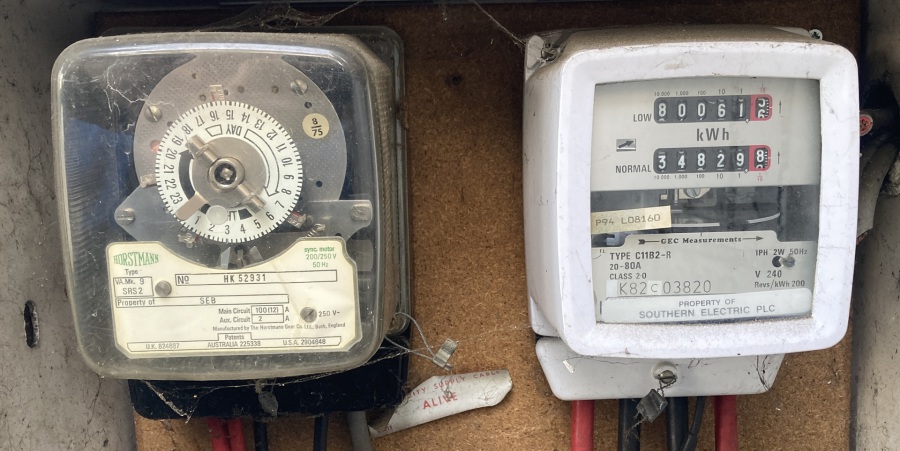 An old style time-switch and dual rate electricity meter
This page is a work in progress. At the time of writing, the methodology for EPC assessments of existing dwellings is RDSAP 10. A significant methodology overhaul from RDSAP to the Home Energy Model (HEM) is proposed for 2026. In addition, government consulations indicate future changes to the format of EPCs and minimum rating levels required for private rental properties. Methods for improving EPC ratings will therefore change in the future.
Introduction
Electricity and Gas meters measure the amount of these fuels consumed in a property.
- Electricity is measured in kilowatt-hours (kWh)
- Gas is measured in cubic metres (m3)
The quantity of gas used (m3) can be converted to kWh using the industry standard formula (in the UK) as follows:
kWh = (m3 x Volume Correction Factor x Calorific Value) / 3.6
Where: Volume Correction Factor is 1.02264 and the Calorific Value is shown on your gas bill but is around 39 to 40 MJ/m3. Dividing by 3.6 then converts from megajoules to kWh.
The EPC assessment methodology assigns a cost in pence per kWh to these fuels and these costs are applied in the calculation of the end rating.
Currently, domestic EPC ratings are a cost-based metric and represent the annual cost of running a property, related to the floor area. They consider regulated energy costs which include:
- Space Heating
- Water Heating
- Lighting
- Ventilation
Assumed occupancy models are used in working out how much fuel is used, and this ensures EPC ratings are about the property rather than the occupants and their preferences.
In addition, generation from solar PV offsets electricity usage and excess generation provides a further financial benefit, both of which are applied in the final stages of the calculation.
During an EPC assessment, an energy assessor will record the following information about the meters:
- Is the electricity meter a smart meter?
- Is the electricity meter single rate or dual rate?
- Is the electricity meter export capable?
- Is a mains gas supply present?
- Is the gas meter a smart meter?
This page is about these distinctions and how they can affect the EPC rating of an existing dwelling.
Dual or Single Rate Electricity Meter
Most properties have a meter that charges electricity to the occupier at a fixed rate throughout the whole day, and this is known as a single rate meter.
Any electricity consumed in the property is charged at this single rate and at the time of writing this is likely to be around 24 p/kWh.
This type of meter might typically be the case for properties that have gas boilers, oil boilers, heat pumps and also simple peak rate electric panel heaters.
You'd also expect to find hot water cylinders with single immersion heaters in this type of property.
There are some heating systems however that are designed to work on a dual-rate arrangement, whereby they consume cheaper electricity overnight to 'charge up', and the occupier utilises that stored heat during the day when the rate is more expensive.
Typically at the time writing the rates may be 30p/kWh during the day and 13p/kWh at night.
The most common of these systems include:
- Night Storage Heaters
- Hot water cylinders with dual immersion heaters
During EPC assessments, assessors check the electricity meter to see if they can view details of dual rates, ie peak rate and and off-peak rate.
If they can, they record the presence of a dual rate meter. Otherwise, a single rate meter is recorded.
Photographs of the meter displays are useful as evidence in the case of an audit.
Alternatively, photos of the occupant's electricity bill showing dual rates can be used as evidence.
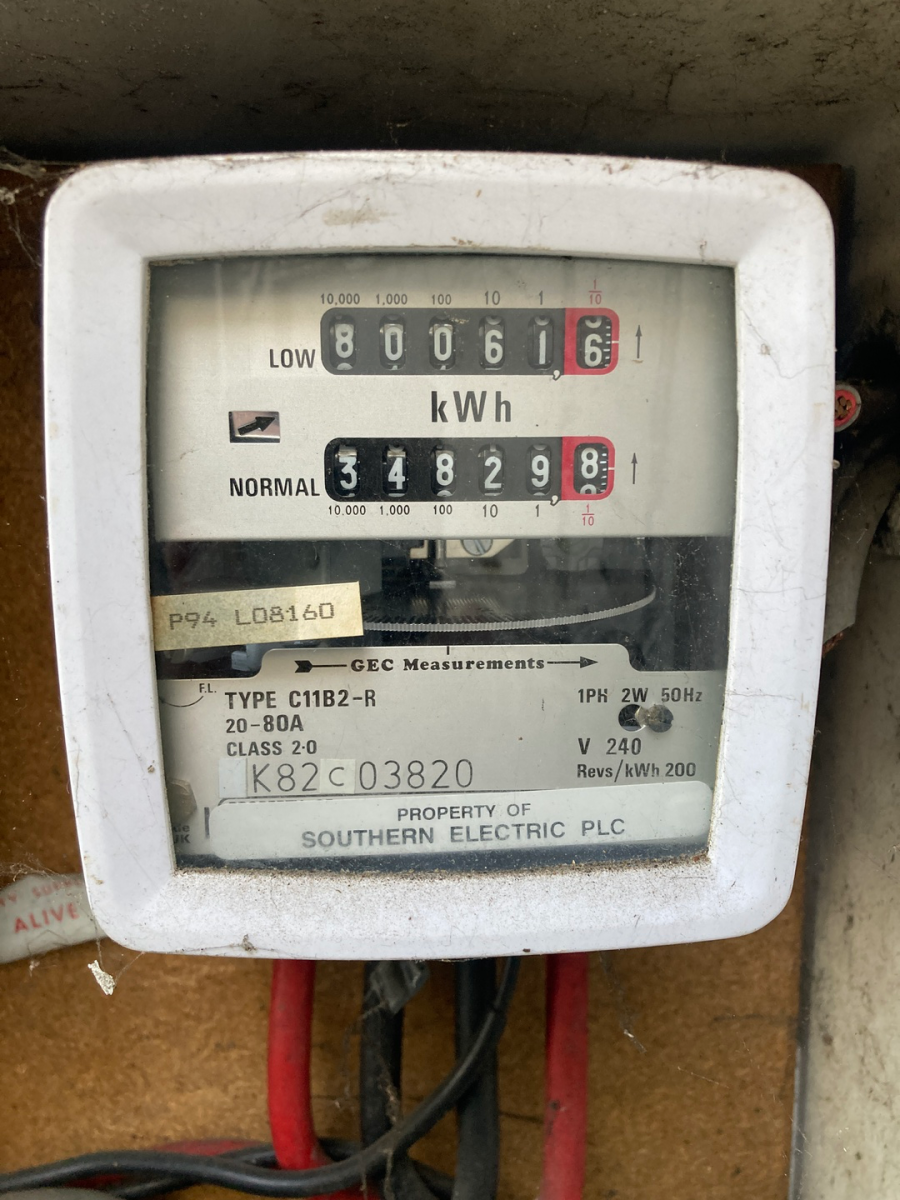 Older style dual-rate electricity meter
This is an example of an older style dual-rate electricity meter, and the two rates with their separate readings are clearly visible.
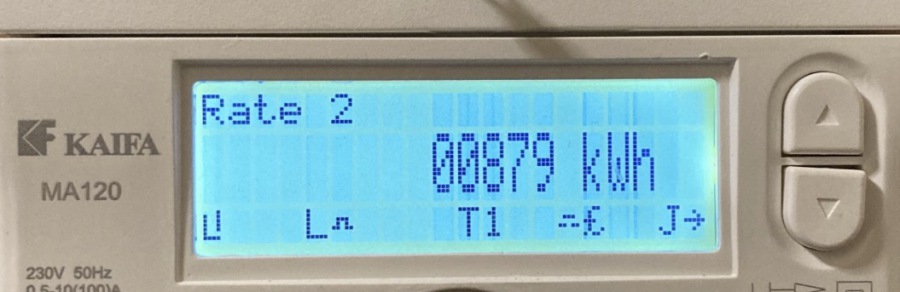
This next example is of a modern smart electric meter, and the display here has been photographed on the rate 2 reading page, thus confirming it's a dual rate meter....
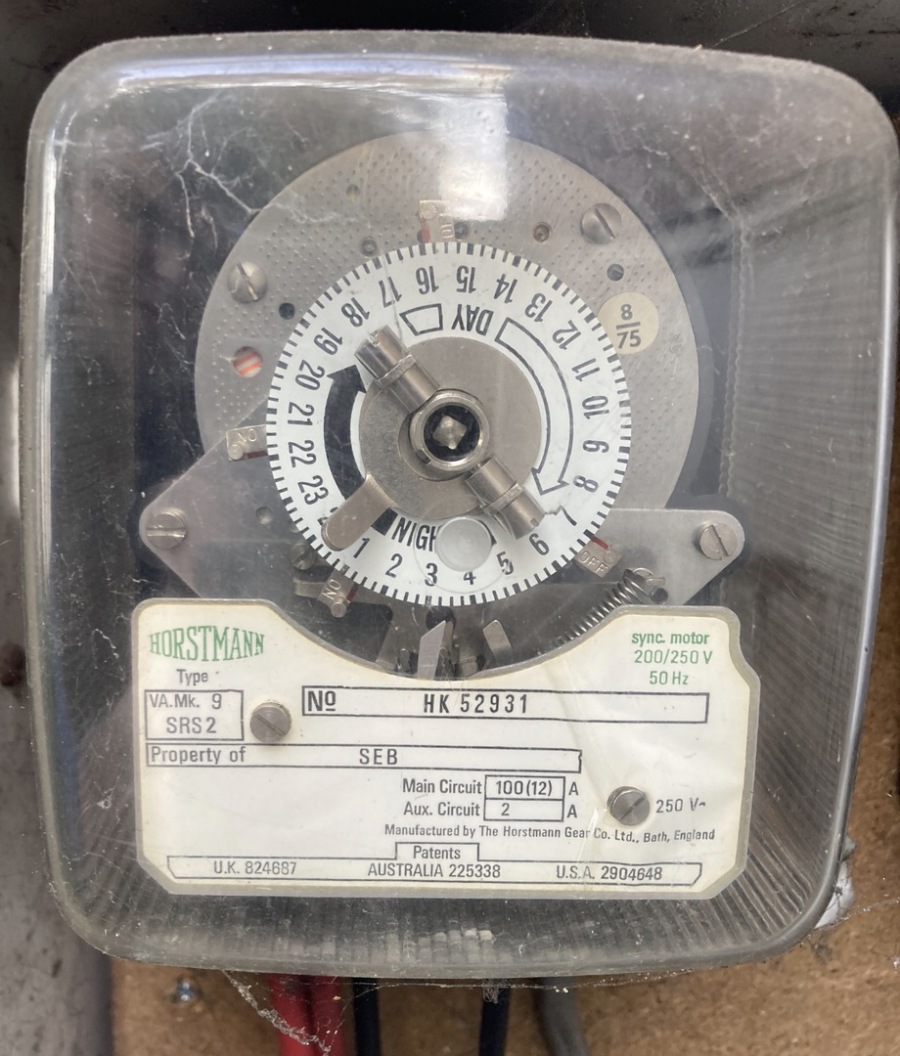
With older meters, the mechanism for switching between the normal and low rates is often via a separate device connected to the meter. This for example is an old. mechanical electrical timer switch.
Modern meters however contain all the circuitry they need to record at which rate the electricity is being charged.
There is an old system however you may occasionally come across which is being decommissioned called RTS, and if you still have such a system it may now be malfunctioning.
Radio Teleswitch Service (RTS)
The radio teleswitch service is an old system that used a radio signal to switch certain dual rate electricity meters from peak to off-peak rate and back gain each day.
The signal was transmitted on longwave radio, specifically piggybacked onto the BBC Radio 4 AM signal.
RTS was introduced in the 1980s and after various postponements it's decommissioning started in June 2025.
If you still have an RTS controlled meter, it's quite possible the time switching feature has now stopped working, and you should seek to get it replaced as soon as you can.
Since 1st May 2025, if a radio tele-switch is present in a property the meter will be recorded as a single rate meter in any new EPC assessment (Convention 9.13).
Some of these RTS controlled meters still remain in place so it's still possible to come across them from time to time.
EPCs - Single Rate vs Dual Rate
There are some scenarios where a heating system is present that would normally require a dual-rate meter but where a single rate meter is present.
If storage heaters are present but there is only a single rate electricity meter present then the heaters will be recorded in an EPC assessment as standard electric panel heaters (Convention 4.2). This will adversely affect the rating compared to that which would have been obtained if a dual rate meter had been present.
If a hot water cylinder is present with dual immersion heaters but there is only a single rate electric meter, the cylinder is entered as only having a single immersion (Convention 6.03).
Landlords and homeowners therefore might be interested in reviewing their electricity meter and heating arrangements to make sure an EPC assessment makes the best outcome for their property.
Export Capable Electricity Meter
An export capable electricity meter is one that can measure the amount of imported and exported electricity.
Imported electricity is that which is consumed from the grid.
Exported electricity is that which flows in the opposite direction. This could for example be excess electricity generated by solar PV panels that is sent back to the grid.
An assessor will see if information can be displayed on the meter showing exported kWh. A photo of the meter screen helps towards evidence for audit purposes.
'Export capable' however would normally be assumed in the case of a smart meter.
Alternatively, sight of the owners utility bill showing export information would also suffice.
The selection of an export capable electricity meter as opposed to one that is not export capable makes some differences to the EPC certificate. For example:
- If solar panels are present at a property but the electricity meter is not export capable then the excess PV generation is not deemed to be exported to the grid and the EPC rating is therefore limited, sometimes significantly.
- If solar panels are not present at a propety and the electricity meter is not export capable, then any Potential EPC rating indicated against the Solar PV recommendation on the EPC will also be limited.
An export capable meter would also be expected where a wind turbine or small scale hydro system are present.
Smart Meters
Previously, EPC assessments didn't record whether electricity or gas meters were smart enabled. The only information recorded was whether an electricity meter was single or dual rate and whether a mains gas supply was present.
Since the introduction of RDSAP 10 on 15th June 2025 however this additional information is now recorded although there is currently no effect on the EPC rating.
The textual content of the current EPC certificates does change slightly when smart meters are indicated so an error in getting this right could result in a failure if picked up at audit.
The information provided by these questions is likely to provide statistical information for the government going forwards and support future EPC multi-metrics such as the proposed Smart-Readiness metric in England & Wales.
Upgrading to a Smart Meter
If you have a meter that is not smart enabled, you can ask your energy supplier to replace it with one that is.
In fact they are usually very keen for this to be done.
Mains Gas Supply Available
'Mains gas supply available' is chosen if there are gas appliances in the property, or if a gas meter is present (Convention 8.02).
If 'mains gas available' is indicated in an assessment, recommendations may appear on an EPC to change non-gas heating and hot water supplies to gas-fired systems.
Click here to return to our 'Improve Your EPC' main page, and see if there is another way you could improve your EPC rating
 Print
Print 