
Internal / External Wall Insulation
This page is a 'Work in Progress'
At the time of writing, the methodology for EPC assessments of existing dwellings is RDSAP 10. A significant methodology overhaul from RDSAP to the Home Energy Model (HEM) is proposed for 2026. In addition, government consulations indicate future changes to the format of EPCs and minimum rating levels required for private rental properties (MEES). Methods for improving EPC ratings will therefore change in the future.
Introduction
Internal Wall Insulation (IWI) and External Wall Insulation (EWI) are two commonly used methods of improving the energy performance of solid brick or stone walls.
They can also be used to further improve the performance of cavity walls, but with these, the approach is normally to fill the cavity with insulation first.
Internal Wall Insulation involves applying insulation to the inside face of your external walls. You retain the original outer face of the building, but you build on the interior side — typically by fixing insulation boards or batts, often within wood battens, then putting up an insulated plasterboard finish.
External Wall Insulation covers your external walls from the outside. Insulation panels are fixed to the exterior brickwork, and then a weather-proof render or cladding is applied over them.
Internal Wall Insulation
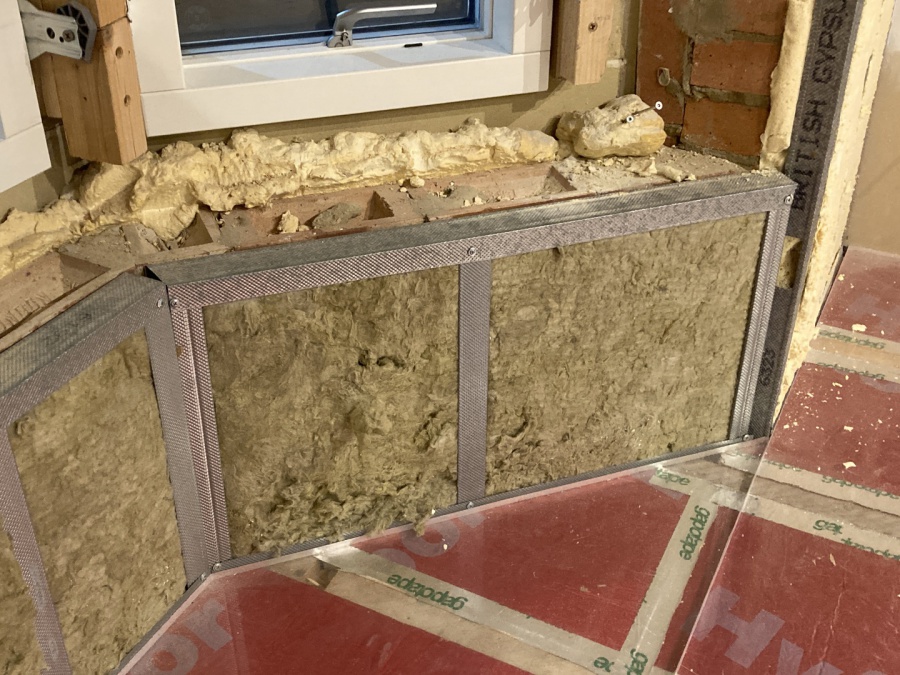
Here is an example of internal wall insulation being installed. This is at an exhibit called 'Renovation House' at the National Self-Build and Renovation Centre (NSBRC) in Swindon.
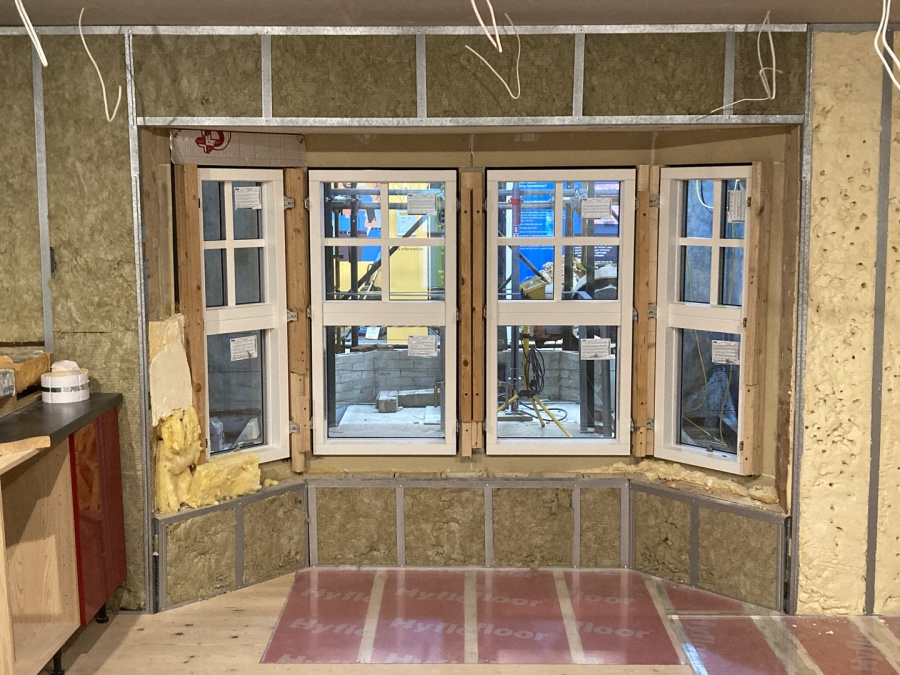
The mock-up is that of a house with cavity walls, but the system being showcased here is internal wall insulation which is commonly used on solid walls. This particular system uses a metal studwork formation filled with mineral wool batts, which are then covered with board.
External Wall Insulation
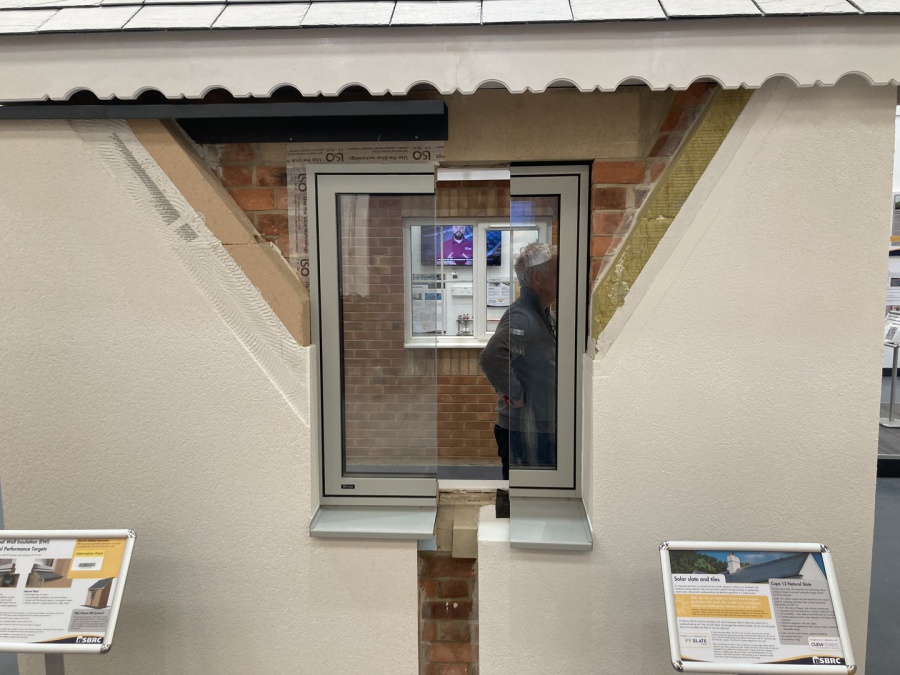
Here are two examples of External Wall Insulaton, in the Retrofit area of the National Self Build and Renovation Centre in Swindon.
Both are PRB EWI Systems and are built up to provide a wall u-value of 0.3 W/m2K.
The system on the left includes 120mm thickness of wood-fibre insulation, and is finished with a mono-couche mineral render. The window has also been brought forward slightly using a special frame for improved thermal bridging (not recorded for an RDSAP EPC assessment) and to provide a modern appearance.
The system on the right includes 110mm of mineral wool which is non-combustible, breathable and sound-insulating. The finish is a thin-coat render. The window is retained in its original position for a deep reveal.
Building Control
The performance of a solid wall insulation system will depend on insulation type and thickness and the existing wall. The specification must meet or exceed the current regulation: Retrofit with EWI: 0.30 W/m2K
Under Approved Document L (Conservation of fuel and power), Building Regulations apply if you renovate a “thermal element” such as a wall, roof, or floor, over a significant area.
If you add, replace, or upgrade any insulation to a wall for example, whether internally or externally, it’s considered “building work” under the Building Regulations.
This means you must notify Building Control (either through your local authority or an approved inspector), unless the work is carried out by a registered installer under a competent person
scheme.
A 50% rule applies - If you renovate more than 50% of the total surface area of a single thermal element from inside (for example, an external wall in a single room), then you are required to notify Building Control and upgrade the insulation to meet certain thermal standards. This is demonstrated in Diagram 11.2 from Approved Document Part L:
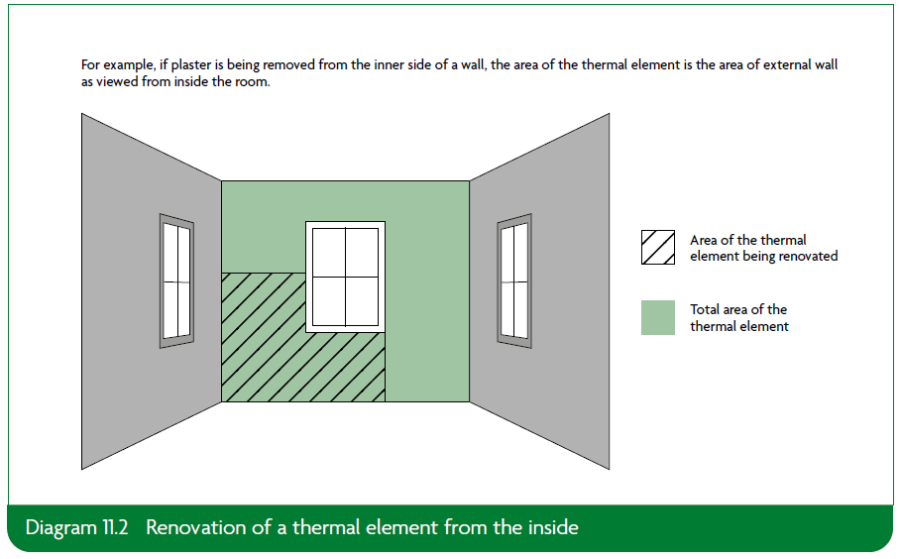
If you’re renovating less than 50% of that element, you usually don’t need to notify Building Control specifically for energy performance, although the work must still meet other relevant parts of the Building Regulations.
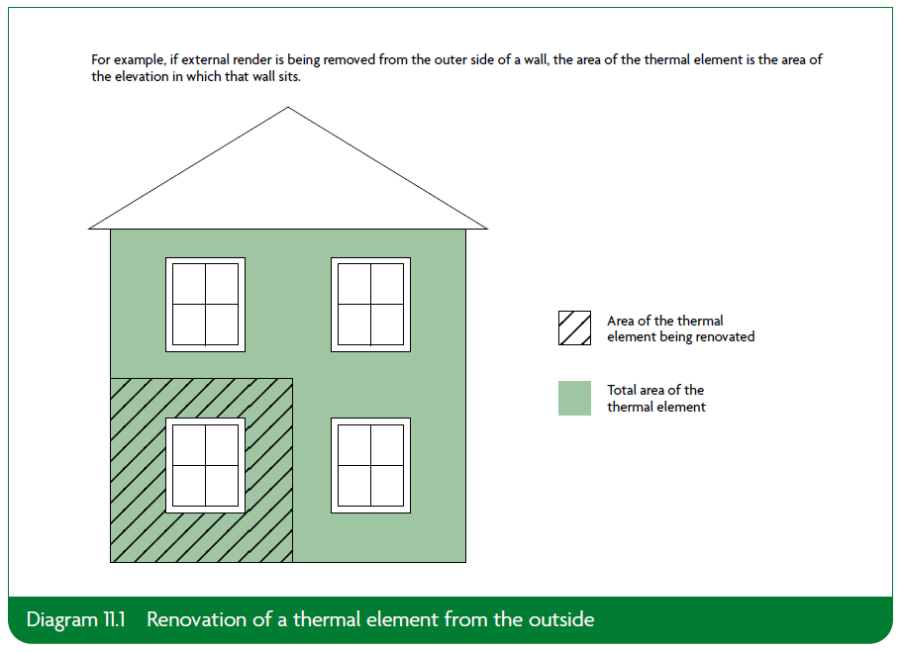
Another rule applies if you are renovating 25% of the external envelope of the property. This is demonstrated in Diagram 11.1 of Approved Document Part L:
Contacting Building Control is often overlooked by homeowners upgrading insulation themselves, and also overlooked by many builders.
By operating through Building Control, you will ensure the works you conduct are compliant, and you'll avoid issues when you come to sell the property in the future.
Also a building control completion certificate can be used towards 'documentary evidence' that insulation has actually been added to the wall, therefore making it much easier for it to be taken into account in an EPC assessment.
Documentary Evidence
RDSAP10 - Changes to solid wall u-values
I mention this information in passing only because it relates to solid stone/brick walls, which are the type of walls that we are interested in on this page.
The EPC assessment methodology for existing dwellings was updated on the 15th June 2025 from RDSAP 9.94 to RDSAP 10.
A change was made in the new methodology to how u-values for solid walls are calculated for the early construction datebands.
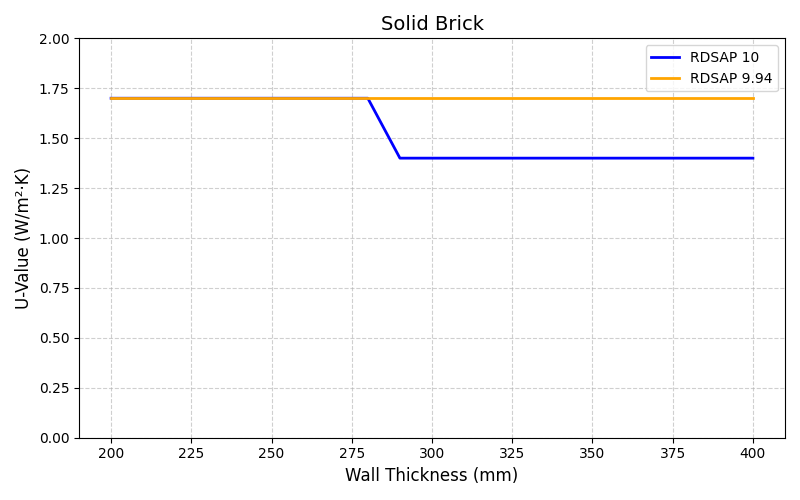
The following graphs show u-value reference curves for solid walls, comparing RDSAP 10 with the previous methodology, RDSAP 9.94:
There are graphs for Sandstone/Limestone, Granite/Whinstone and solid brick.
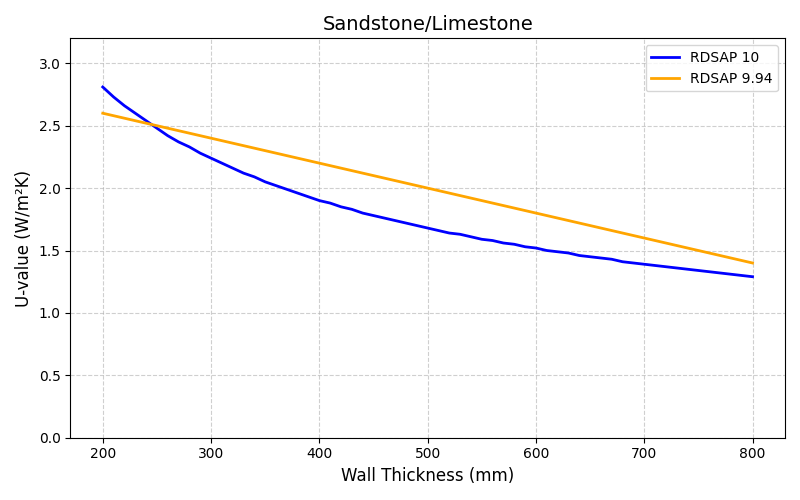
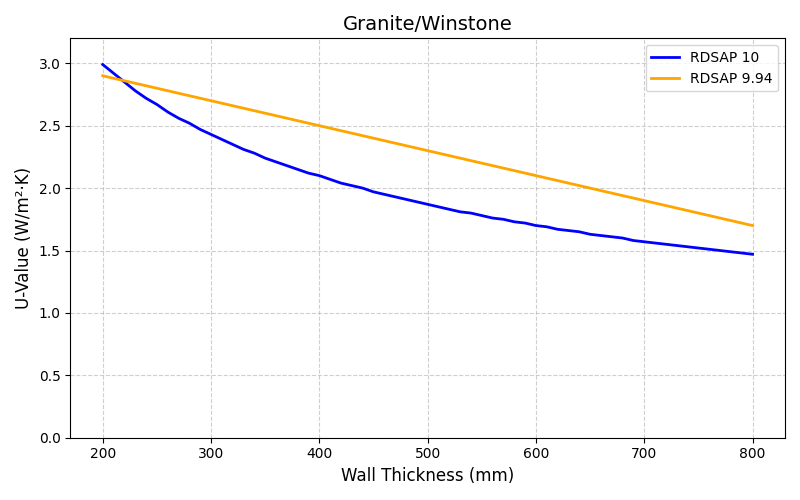
For both of the solid stone graphs, where walls are typically 400mm or more in thickness, you can see the newer methodology provides a u-value that is slightly more generous, ie less lossy, than the previous methodology.
For solid brick walls you can see that previously there was a fixed u-value, irrespective of the wall thickness, but now there is a step change at 280mm from a u-value of 1.7 to 1.4.
This will be at the threshold of a solid brick wall being two or three bricks thick. It would appear that a solid brick wall that is three bricks thick will now have a better u-value compared with the previous methodology.
Further information to follow shortly.
Click here to return to our 'Improve Your EPC' main page, and see if there is another way you could improve your EPC rating.
 Print
Print 