
Become Qualified as a Domestic Energy Assessor (DEA)
Introduction
I wonder, have you ever considered becoming qualified as a Domestic Energy Assessor (DEA)?
You might assume that obtaining the qualification is something you'd only consider if you wanted to start a career producing Energy Performance Certificates (EPCs). However, there may be other reasons why it could be worth considering.
For example, if you're a landlord, property investor or responsible for managing a number of properties, understanding how EPC assessments work could prove surprisingly useful.
You'll learn how properties are assessed, what information is collected and how different features of a building influence its EPC rating. With further experience and a little experimentation, you'll also develop the ability to model potential improvements and see how they might affect a property's rating.
This could help you make more informed decisions about renovation works, energy efficiency improvements and future investment in your properties.
Of course, becoming qualified involves a financial commitment, and there are ongoing costs and responsibilities if you decide to become an accredited assessor and start lodging EPCs. I'll look at those in more detail throughout this guide.
I'll also explore some of the additional skills and opportunities that can follow from obtaining a DEA qualification, including calculating U-values and potentially progressing into other areas of energy assessment.
What Does a Domestic Energy Assessor Actually Do?
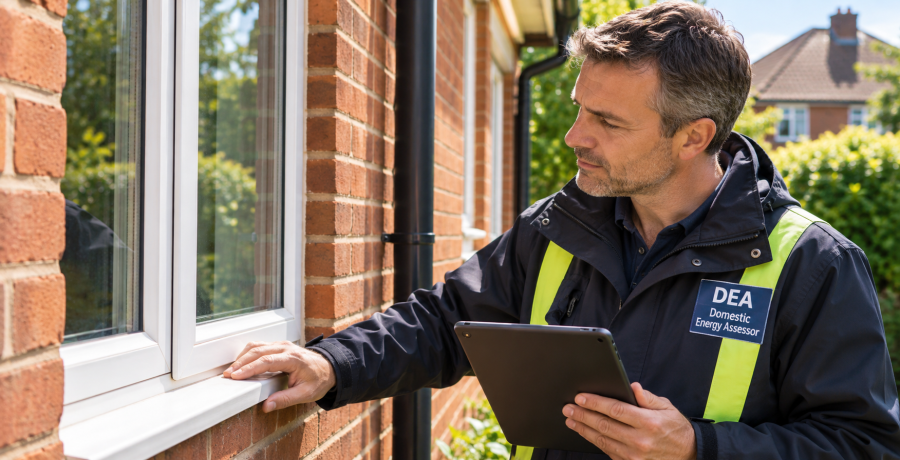
A Domestic Energy Assessor (DEA) is responsible for carrying out energy assessments of existing residential properties and producing Energy Performance Certificates (EPCs).
The assessment involves collecting information about the property, its construction and the various features that influence its energy performance.
This includes:
-
Property construction: Establishing the age, construction type and dimensions of the property, including its walls, floors and roof.
-
Insulation: Identifying the type and extent of insulation present, including cavity wall, loft and floor insulation.
-
Heating and hot water: Recording the main heating system, secondary heating, hot water arrangements and associated controls.
-
Windows and doors: Recording glazing types, window characteristics and other relevant features.
-
Lighting: Establishing the proportion of fixed lighting that uses energy-efficient lamps.
-
Renewable technologies: Identifying features such as solar photovoltaic panels, solar thermal systems and other recognised technologies.
The assessor enters the information into approved assessment software, which uses the current government methodology to calculate the property's energy performance and generate its EPC.
The assessment is primarily a visual inspection, supported by any relevant documentary evidence provided by the property owner. Assessors need to understand what can be established through inspection and where additional evidence may be required to support a particular entry.
It's worth remembering that an EPC assessment is not a building survey. A DEA isn't undertaking a structural inspection or investigating every aspect of a property's condition. Their role is specifically to assess the features that influence its energy performance under the prescribed methodology.
Once the assessment is complete, the EPC is lodged on the national register and made available to the property owner or their representative.
At A Glance
In this section we'll learn:
- What a Domestic Energy Assessor does and what the job involves.
- How to become qualified, including training and assessment requirements.
- The costs involved, both initially and on an ongoing basis.
- The benefits of qualifying, even if you don't intend to work as an assessor.
- Further opportunities, including U-value calculations and other areas of energy assessment.
- Whether it's worth doing, particularly if you own or manage several properties.
Becoming Qualified as a Domestic Energy Assessor
To become a Domestic Energy Assessor, you'll need to obtain a recognised Level 3 qualification in Domestic Energy Assessment.
There are several training providers offering courses, with options for classroom-based and online learning. You don't necessarily need previous experience in the construction or property industry, although having some familiarity with buildings and building services can be helpful.
What does the training involve?
The training covers the knowledge and practical skills needed to carry out domestic energy assessments. This includes:
-
Understanding different types of building construction and how properties are assessed.
-
Identifying insulation, heating systems, hot water arrangements and other relevant building features.
-
Understanding how information is collected and entered into RdSAP assessment software.
-
Producing EPCs and understanding how the recommendations are generated.
-
Understanding the conventions and requirements that assessors must follow.
The Assessment Process
Completing the training course is only part of the process. You'll also need to demonstrate that you can carry out assessments correctly.
This generally involves completing a portfolio of property assessments, which are submitted for evaluation by the awarding organisation. Depending on the training provider, this may include simulated assessments as well as visits to real properties.
For example, Sava's current qualification involves five case studies, including simulated assessments and three visits to actual properties.
How Long Does It Take?
The training itself can be relatively short. Some providers offer intensive courses lasting three to five days, while others offer self-paced learning.
However, you'll need to allow additional time to complete your assessment portfolio and achieve the qualification. The overall time will depend on the training provider, the course format and how quickly you can arrange suitable properties for assessment.
Once you've successfully completed the qualification, you'll have the academic credentials needed to progress towards becoming an accredited Domestic Energy Assessor.
Accreditation and Becoming an Active DEA
Obtaining your Level 3 qualification is an important milestone, but it doesn't automatically allow you to start producing EPCs.
To work as a Domestic Energy Assessor, you'll also need to join an approved accreditation scheme. These organisations are responsible for monitoring the quality of assessments, providing technical support and ensuring their members continue to meet the required standards.
There are several accreditation schemes available, including Elmhurst Energy, ECMK and Quidos. Each has its own membership arrangements, services and fee structure.
What Does Accreditation Involve?
When applying to join an accreditation scheme, you'll generally need to provide:
-
Evidence of your recognised DEA qualification.
-
Proof of identity and relevant personal details.
-
A criminal record or basic disclosure check, where required.
-
Evidence of appropriate professional indemnity and public liability insurance, or arrangements to obtain cover through the scheme.
Once your application has been approved, you'll be provided with access to the scheme's assessment software and the facilities needed to lodge EPCs on the national register.
Ongoing Responsibilities
Becoming accredited isn't simply a one-off exercise. You'll be expected to maintain your professional competence and comply with the scheme's requirements.
This includes:
-
Continuing Professional Development (CPD): Keeping your knowledge up to date through training, technical updates and other learning activities.
-
Quality assurance: Your assessments may be selected for auditing to check that they have been completed correctly and comply with the relevant conventions.
-
Insurance: Maintaining appropriate professional indemnity and public liability insurance.
-
Technical compliance: Following the current assessment methodology, conventions and guidance issued by your accreditation scheme.
Accreditation schemes also provide access to technical support, software updates and guidance to help assessors carry out their work.
Once accredited, you'll be able to undertake assessments independently and lodge EPCs, provided you continue to meet the requirements of your scheme.
It's worth researching the different accreditation providers before choosing one. Their membership costs, software, lodgement fees and support arrangements can vary considerably, and the cheapest option isn't necessarily the best choice for everyone.
How Much Does It Cost to Become a DEA?
Before embarking on a DEA qualification, it's worth considering the financial commitment involved. There are several costs to take into account, both when getting started and once you become an accredited assessor.
Initial Training and Qualification
The first expense is the training course itself. Prices vary between providers, depending on the course format and what is included.
You should check whether the advertised price includes registration with the awarding organisation, assessment fees, training materials and any additional costs associated with completing your qualification.
It's also worth allowing for the possibility of having to pay for additional assessment attempts or support if you don't complete the qualification first time.
Accreditation and Ongoing Costs
Once qualified, you'll need to consider the costs associated with joining and remaining with an accreditation scheme.
These can include:
-
Membership or renewal fees: Some schemes offer free annual DEA membership, while others may charge depending on the number of EPCs you lodge.
-
EPC lodgement fees: A fee is charged each time you lodge an EPC.
-
Central register fees: These are additional to the accreditation scheme's own lodgement charges.
-
Insurance: Professional indemnity and public liability cover may be included in your membership or charged separately.
-
Software: Some schemes provide software free of charge, while others charge for particular applications or services.
-
Continuing Professional Development: Additional training may sometimes involve extra costs.
What Do Accreditation Schemes Charge?
To give you an idea of the differences, here are some examples of currently published fees:
-
Elmhurst Energy: Free initial DEA accreditation. Annual renewal is free for assessors lodging at least 30 EPCs during the previous accreditation year; otherwise, the published renewal fee is £125 plus VAT. Its advertised EPC lodgement fee starts at £6.89 plus VAT.
-
ECMK: Free annual DEA membership, with a published EPC lodgement fee of £3.23 plus VAT.
-
Quidos: Offers different membership packages. Its Bronze package has no monthly membership fee, with EPC lodgements advertised at £5.60 each, while higher packages include a monthly fee and a number of inclusive lodgements.
These are examples rather than a direct comparison of like-for-like services. The fees, included services and additional charges vary, so it's worth checking the latest price lists before making a decision.
Other Business Expenses
If you intend to work professionally as a DEA, there are also practical expenses to consider.
You'll need suitable transport to visit properties, a reliable computer or mobile device, and a laser measuring tool and other equipment used during assessments.
You may also need to budget for website hosting, advertising, accountancy and other general business expenses if you're operating independently.
My advice: Don't base your decision solely on the cost of the initial qualification. Think about how many EPCs you're realistically likely to produce and whether the ongoing costs of accreditation and running a business are justified.
The Benefits of Becoming a DEA - Even If You Don't Intend to Produce Many EPCs
You might be wondering why anyone would go to the expense and effort of becoming a qualified Domestic Energy Assessor if they don't intend to make a living producing EPCs.
There are actually some interesting benefits, particularly if you're a landlord, property investor or involved in renovating residential properties.
Understanding How EPCs Work
One of the biggest advantages is developing a proper understanding of how EPC assessments are carried out.
You'll learn how different aspects of a property's construction, insulation, heating and hot water systems influence its energy performance. You'll also gain an understanding of the RdSAP methodology and how the various inputs affect the final rating.
This knowledge can be particularly useful when considering improvements to a property. Rather than relying entirely on the recommendations contained in an existing EPC, you'll have a much better understanding of why those recommendations have been made and what other options might be available.
Making Better Investment Decisions
For landlords and property investors, this knowledge could prove particularly valuable.
Before committing to expensive improvement works, you could investigate how different combinations of measures might affect a property's EPC rating.
For example, would replacing an existing heating system offer a greater improvement than upgrading the insulation? Would solar PV make a worthwhile difference? Could relatively inexpensive improvements be enough to move a property into the next EPC band?
Understanding the assessment methodology can help you make more informed decisions and avoid spending money on improvements that deliver little benefit to the property's rating.
Understanding the Limitations of EPCs
Another benefit is developing a better appreciation of what an EPC can and cannot tell you.
EPCs are produced using a standardised assessment methodology. They provide an indication of a property's modelled energy performance, rather than a measurement of how much energy an individual household actually consumes.
Understanding how the assessment works, what assumptions are made and where documentary evidence is required can help you interpret EPC results more critically.
It can also be useful when reviewing EPCs produced by other assessors, particularly where you believe certain features of a property may not have been recorded correctly.
A Useful Skill Beyond Property Ownership
Even if you don't own a portfolio of properties, the knowledge gained through DEA training could be useful in other areas.
You might be involved in property renovation, building maintenance, estate agency or property management. Having a better understanding of energy efficiency and EPC assessments could complement your existing skills and help you provide more informed advice.
An important distinction: Obtaining the qualification gives you the knowledge and skills, but if you want to produce EPCs and use the associated assessment software, you'll still need to become accredited and meet the relevant scheme requirements. That brings additional costs, which need to be considered if you don't intend to earn money from assessments.
Beyond the DEA Qualification - Other Opportunities
Obtaining a DEA qualification can be a useful starting point if you're interested in developing your knowledge of building energy performance. There are several other areas you could explore, some of which offer opportunities to develop additional professional skills.
U-value Calculations
One particularly interesting area is calculating U-values for building elements such as walls, floors and roofs.
A U-value measures the rate at which heat passes through a building element, with lower values indicating better thermal performance.
Understanding how these calculations work can be extremely useful when assessing properties, particularly where insulation has been added and the actual construction differs from the assumptions normally used by RdSAP.
For example, if a property has been retrofitted with internal wall insulation, being able to establish the resulting U-value could help ensure that the improvement is accurately represented in an EPC assessment.
There are additional competency requirements if you intend to produce U-value calculations for use as supporting evidence in EPC assessments. Simply holding a DEA qualification does not automatically qualify you to provide these calculations.
On-Construction Domestic Energy Assessment (OCDEA)
Another possible progression is into On-Construction Domestic Energy Assessment (OCDEA).
Whereas a DEA assesses existing properties using RdSAP, an OCDEA works with new dwellings, using the full Standard Assessment Procedure (SAP) methodology.
This involves a more detailed assessment, generally using information from building plans, construction specifications and details of the building services installed.
OCDEAs work with housebuilders, developers and other construction professionals to assess the energy performance of new homes and produce the relevant EPCs.
It requires a separate qualification and accreditation, but could be an interesting option if you want to develop your knowledge beyond existing dwellings.
Further Opportunities
There are also other areas of energy assessment and building performance worth exploring, including non-domestic energy assessment, retrofit assessment and building fabric performance.
The skills and knowledge gained through DEA training can provide a useful foundation, although each of these areas has its own qualification and competency requirements.
If you're interested in the technical side of building energy performance, becoming a DEA could be the beginning of a much wider learning experience.
Is Becoming a DEA Worth It?
Whether becoming a Domestic Energy Assessor is worthwhile really depends on what you hope to get out of the qualification.
If your intention is to establish a business producing EPCs, you'll need to consider the level of demand in your area, the competition and the fees you can realistically charge.
The DEA market can be competitive, and there is considerable variation in the prices charged for assessments. You'll also need to factor in travel time, accreditation costs, insurance, software and other business expenses.
It's worth doing some research before committing to the qualification, rather than assuming that completing the training will automatically lead to a steady stream of work.
What About Landlords and Property Investors?
I think there is a particularly interesting proposition for landlords, property investors and people involved in property renovation.
Developing a thorough understanding of how EPC assessments work can be extremely useful if you own or manage several properties.
You'll gain an insight into how different aspects of a property's construction and heating systems influence its EPC rating, why certain recommendations appear and how potential improvements are assessed.
This knowledge could help you make better-informed decisions about renovation works, energy efficiency improvements and future investment in your properties.
If you're primarily interested in developing this knowledge rather than establishing yourself as a working DEA, it's worth considering whether the full qualification is the most appropriate route. There are also shorter courses and other training opportunities that may provide a more suitable introduction.
My View
I think becoming a DEA is an interesting option for anyone with a genuine interest in property construction and energy efficiency.
For someone intending to work as an assessor, it can provide the foundation for a new business or career, although the financial rewards will depend on how effectively they establish themselves in what can be a competitive market.
For landlords and property investors, developing a proper understanding of EPC methodology could be equally valuable. It can help you make better decisions about your properties and avoid spending money on improvements that offer little benefit.
Ultimately, I'd encourage anyone considering the qualification to look beyond simply obtaining another certificate. The real value is in the knowledge and understanding you develop along the way.
Key Takeaways
-
The qualification: Becoming a Domestic Energy Assessor requires a recognised Level 3 qualification in Domestic Energy Assessment.
-
The training: Courses cover building construction, insulation, heating systems, RdSAP methodology and the practical assessment process.
-
Accreditation: Qualifying is only the first step. You'll also need to join an approved accreditation scheme before you can lodge EPCs.
-
Ongoing costs: Membership, lodgement fees, insurance, software and continuing professional development all need to be considered.
-
Benefits beyond EPCs: Understanding the assessment methodology can be particularly useful for landlords, property investors and those involved in property renovation.
-
Further opportunities: The DEA qualification can provide a foundation for developing additional skills, including U-value calculations and progressing into OCDEA work.
-
Is it worthwhile? That depends on your objectives, but the knowledge and understanding gained can be valuable well beyond simply producing EPCs.
My advice: Research the training providers and accreditation schemes carefully before committing. Consider both the initial investment and the ongoing responsibilities involved.
Click here to return to our 'Improve Your EPC' main page, and see if there is another way you could improve your EPC rating.
 Print
