
EPC Ratings Explained
The Energy Efficiency Rating (EER)
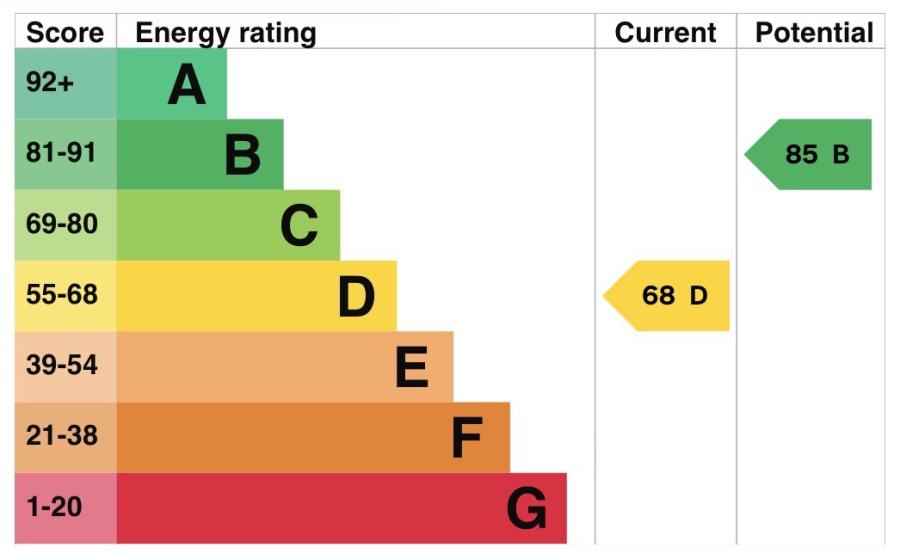
The headline rating on domestic EPCs is the Energy Effciency Rating (EER).
This is displayed on a multi-coloured scale with a 'current' value, and a 'potential' value which could be achieved if all the listed recommendations are implemented.
A higher rating indicates a more 'energy efficient' property, and a lower score a less 'efficient' one.
The rating is actually a representation of the annual modelled running costs of the property, related to floor area, so in effect it is purely a cost-based metric.
The running costs involved in the calculation include:
- Space Heating
- Water Heating
- Lighting
- Ventillation
- Pumps & Controls
These are known as regulated energy costs
'Regulated' in this context doesn’t infer price controls, but rather means energy uses that are included and controlled within the EPC calculation methodology.
These costs are modelled under fixed assumptions so that different dwellings can be fairly compared, regardless of how occupants actually use the services within the dwelling.
EPCs deliberately exclude energy that depends heavily on occupant behaviour such as:
- Cooking appliances
- TVs, computers, and electronics
- Plug-in devices
- Portable heaters
- Refrigeration
These are called unregulated loads and are not part of EPC energy cost calculations.
The modelled annual running costs of the dwelling are related to the floor area of the dwelling as an Energy Cost Factor (ECF) via the following equation:

(floor area is Gross Internal Area in square metres, the energy cost deflator is discussed further down but currently is 0.42 for existing dwellings (see table 32, RDSAP 10.2 Specification document) and the total energy cost is in £)
Then the ECF is used to calculate the EER as follows:
If the ECF is greater than or equal to 3.5 then:

Or otherwise, if it is less than 3.5:

In the assessment software, this rating is calculated to 4 decimal places and then rounded to the nearest integer.
For ratings with a fractional component of 0.0001 to 0.4999 it is rounded down.
For ratings with a fractional component of 0.5000 to 0.9999 it is rounded up.
If the result of the rating is less than 1, the rating is quoted as 1.
This is the final integer rating that we are used to seeing and it is deemed to fall within a certain band, depending on its value as follows:
| EER Value | Band |
| 92+ | A |
| 81 to 91 | B |
| 69 to 80 | C |
| 55 to 68 | D |
| 39 to 54 | E |
| 21 to 38 | F |
| 1 to 20 | G |
An EPC rating therefore consists of both the numerical value and band letter combined, for example 69C.
Note that there is no upper bound for the A band. EPC ratings greater than 100 are possible and indicate the modelled property creates a financial surplus from microgeneration over the cost of energy it consumes.
Fuel Costs & Deflator
Two sets of fuel costs are used behind the scenes in producing an EPC certificate for a dwelling.
The first set is used in calculating the headline EPC rating (the EER) as described above. These fuel costs are static and are rarely changed, perhaps only when a significant methodology update occurs. For existing dwellings, these have remained the same since perhaps 2012, even with the update to RDSAP 10. For new builds, these prices were last changed in 2022 when that methodology was updated to SAP 10.2.
The other set is used for the indicated running costs and the financial improvement figures for EPC recommendations. These fuel costs are updated every 6 months in order to remain representative.
Keeping the first set of costs constant for so long has maintained a level of consistency with EPC ratings for existing dwellings over time.
There is however a facility to adjust the level of ratings if the prices were to be changed, such as happened for new builds in 2022. This is the 'cost deflator' mentioned earlier.
The energy cost deflator is a factor that's varied with the weighted average price of heating fuels when they are updated in the methodology. However, individual SAP ratings will still be affected by relative changes in the price of particular heating fuels.
The cost deflator for RDSAP 9.94/SAP2012 was 0.42.
The cost deflator for RDSAP 10 is 0.42 (see table 32 in the RDSAP 10 Specification document).
The cost deflator for SAP 10.2 is 0.36
Standardised Occupancy
To create a level playing field for EPC assessments so that one property can be easily compared to another, the RDSAP methodology makes some standardised assumptions in regard to occupancy.
For example, consider the case where we have two identical properties, perhaps they are both 3-bed mid-teraced houses, both on the same estate, and both built at the same time and with identical heating systems.
In the first one we have a single person living in the property and they tend to only heat the rooms which they occupy such as one bedroom and the lounge, and have the heating on for as little time as possible in order to limit the cost of heating.
By way of contrast, in the second home we have a family of two adults and two children, with the chidren each occupying their own bedroom. They heat all the rooms all of the time because they can afford to and they like being warm.
Consider now that you are looking to purchase a property in this road and both of these properties were for sale.
You examine the EPC certificates for both properties in order to create a comparison which might help you consider one property over the other.
Under the current methodology (time of writing : March 2025 - it is RDSAP 9.94), the current Energy Indicator Rating (EIR) on an EPC is entirely cost based - ie the rating is calculated entirely from the cost of running the property, taking into count the cost of lighting, cost of domestic hot water and cost of space heating, in relation to the floor area.
If the rating were to be calculated based on the individual useage pattern of the current occupier, it would be clear to see that the cost of running the first property would be much less than the cost of running the second property, resulting in perhaps a much more attractive looking rating for the first property.
For a prospective purchaser looking at the EPCs, these ratings would not be reliably representative of the building and therefore would not be of any use in making a judgment about the energy performance of those properties.
Therefore to avoid this happening, the RDSAP methodology uses a set of occupancy assumptions, and these same assumption rules are used across all domestic RDSAP EPCs so that ratings produced can be usefully compared with each other.
For those that are interested, in terms of 'space heating' requirement, it is assumed the property is heated for 9 hours per day for 5 days per week (ie Monday to Friday), and 16 hours per day for 2 days per week (ie Saturday and Sunday). During these days, the living room is heated to 21 degrees C and the remainder of the dwelling is heated to 18 degrees. Overall, this heating pattern is in place for a period of 8 months per year (ie space heating is not required during four months over the summer).
 Print
Print 