
Doors
At the time of writing, the methodology for EPC assessments of existing dwellings is RDSAP 10. A significant methodology overhaul from RDSAP to the Home Energy Model (HEM) is proposed for 2027. In addition, government consultations indicate future changes to the format of EPCs and minimum rating levels required for private rental properties. Approaches to improving EPC ratings will therefore change in the future.
Doors & EPCs - At A Glance
✓ Only external doors are counted
✓ Doors with over 60% glazing are treated as windows
✓ Draughtproofing can be added to older doors
✓ Replacing an old door usually produces only a small EPC improvement
✓ Specific documentary evidence is usually required to realise the benefit of a new door
✓ Always model changes with an assessor before spending money
Introduction
Replacing an old front door might make your home warmer and more secure, but how much difference does it actually make to your EPC rating?
The answer is often much less than people expect.
Doors are an element of 'building fabric' and contribute in a small way to the overall heat loss of a property. This in turn affects running costs and the overall EPC rating.
External doors make up only a very small proportion of the total heat loss area of most homes. Even if the door’s insulation is greatly improved, the effect on the overall SAP calculation is often very modest compared to other improvements such as loft insulation, cavity wall insulation or heating upgrades etc.
How Are Doors Recorded In An EPC Assessment?
Energy assessors record the number of external doors at the property.
Only external doors are effectively considered, or rather doors that are within heat loss walls.
Internal doors within a property are not normally included. Also, the door from a flat to a heated corridor for example is not counted.
Qualifying doors that have a glazing content of 60% or more are recorded as windows in the assessment rather than doors.
It is therefore entirely possible for a property to be assessed as having no doors in the case where all doors are highly glazed or not counted.
In most cases, assessment against the 60% rule is easy to make by simply looking at a door.
In cases where it is not clear, the measurement procedure is as follows:
- Measure the area of the whole door frame
- Measure just the area of the glazing
- Divide the glazed area by the frame area
- Multiply by 100
For each recorded door, the presence or absence of draughtproofing is also recorded.
Assessments only record the presence of doors. Their condition is not recorded.
The assessment methodology assumes the area of a door is 1.85m2, and this cannot be changed.
A pair of French doors is counted as two doors.
Finally, an option is available to indicate that a door is 'insulated'. In effect this provides for the u-value of the door to be manually overridden, but documentary evidence is required.
Default Thermal Performance
The methodology for producing EPCs for existing dwellings is currently RdSAP 10.
This assumes the u-value of a door as follows (extract from the RDSAP 10 Specification document):
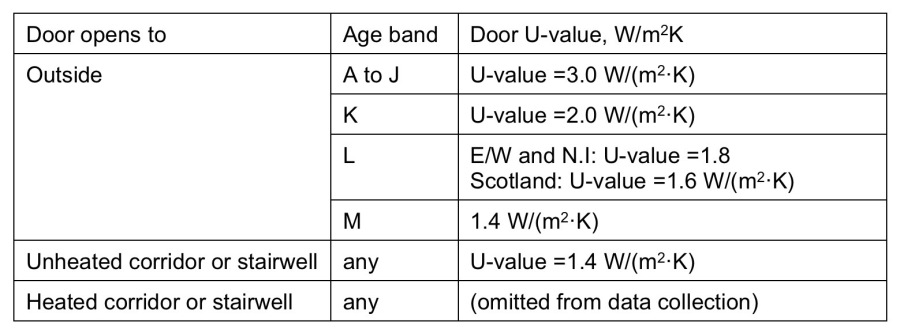
Age bands vary slightly between England & Wales, Scotland and NI, but for England & Wales where I am based, these are:
Age band M is 2023 onwards
Age band L is 2012 to 2023
Age band K is 2007 to 2011
Age bands A-J is up to 2006
So for typical doors leading to outside space, the default u-value depends on the construction age-band of the property.
The value ranges from 1.4 W/m2K for modern dwellings to 3.0 W/m2K for older ones.
Corridors & stairwells in the table refer to flats, and they work a bit differently.
From some quick research, I believe the current worst u-value allowed for new replacement doors in existing dwellings is 1.4 W/m2K.
This effectively fits in with the table above for age band M.
So if we consider the case where you may have an older house, say a 1950s terrace house. If you have brand new replacement doors fitted today then the u-value of those doors will be 1.4 W/m2K (or better) but the methodology would ordinarily assume a value of 3.0 W/m2K instead, unless manually overridden, and supported with documentary evidence.
By way of comparison, I assessed a Passivhaus last year, constructed in 2015, which had doors with u-values of 0.82 W/m2K.
'Insulated' Doors
Doors can be recorded as 'Insulated', and this provides a mechanism for the default u-value to be manually overridden.
The RDSAP 10 Specification document advises about 'insulated' doors as follows:
"A door is counted as insulated only if documentary evidence is provided, which must include U-value or manufacturer reference enabling the assessor to ascertain the U-value from the manufacturer."
So to manually enter the u-value of a door, clear documentary evidence needs to be provided.
Overriding the u-value of doors does not in itself trigger an EPC Smart Audit, but assessors will be keen to make sure sufficient documentary evidence is supplied in case the EPC is ever audited for other reasons.
When Do EPCs Reccommend Draughtproofing Or 'Insulated' Doors?
The following recommendations are available in the methodology relating to doors:
Draught proofing of windows or doors
This recommendation is considered when:
- The existing dwelling has single glazed windows or external doors which are not draught proofed.
It is triggered if:
- The existing dwelling has less than 100% draught proofing of windows and doors.
The rating provided with the recommendation applied includes:
- 100% draught proofing
Insulated doors
This recommendation is considered when:
- The existing dwelling is
- a house, bungalow or park home or
- a (flat or masionette) and (no corridor or more than one door) ie door directly to outside
It is triggered if:
- Door(s) directly to outside not insulated
The rating provided with the recommendation applied includes:
- Change doors directly to outside to insulated doors with u = 1.4 W/m2K
The second recommendation (above) only applies to doors, and not doors that have been recorded as windows.
Separate recommendations exist for windows.
Also, recommendations only appear on an EPC only if they improve the rating by at least 1 SAP point, or 0.5 SAP points in the case of cylinder insulation, draught proofing and low energy
lighting.
Notice the recommendation for 'Insulated doors' implements an improved u-value of 1.4.
All new standard replacement doors fitted today have a u-value of 1.4, so if you have an older property and have a new replacement door fitted today, you need to obtain sufficient documentary evidence from the supplier of the u-value of that door to declare it as 'insulated' and manually override the u-value.
In most cases this information is unlikely to be supplied by default and you will probably need to request it.
How Much Would New Doors Increase My EPC Rating?
Here are some indicative ratings from our Case Study 2 property. This is a 1950s mid-terrace house.
The baseline is with three standard draught proofed doors, with no significant glazing component.
We then try those doors without draught proofing.
We then try the doors with draught proofing again and one by one declare them as 'insulated' and manually overide the u-value with 1.4 W/m2K.
Finally we try all three doors with a u-value of 0.82 which is the performance level of doors in a Passivhaus I assessed in the past.
| Description | EPC Rating | Difference |
| Baseline - 3 doors, 3 DP, 0 Insulated | 67.8978 (68D) | - |
| 3 Doors, 0 DP, 0 Insulated | 67.7449 (68D) | -0.1529 |
| 3 Doors, 3 DP, 1 Insulated (u=1.4) |
68.0978 (68D) |
+0.2000 |
| 3 Doors, 3 DP, 2 Insulated (u=1.4) |
68.2985 (68D) |
+0.4007 |
| 3 Doors, 3 DP, 3 Insulated (u=1.4) | 68.5000 (69C) | +0.6022 |
| 3 Doors, 3 DP, 3 Insulated (u=0.82) | 68.7202 (69C) | +0.8224 |
For this 1950s property, by referring to the u-value table earlier on this page, we can see the methodology will ordinarily use a u-value of 3.0 W/m2K for doors in this property.
If we had replacement doors fitted today, and could provide documentary evidence from the supplier that their u-value was at worst: 1.4 W/m2K, then each door could potentially provide us with a rough additional rating value of 0.2 SAP points each.
Replacement doors might cost around £900 each so that's quite a lot of money to invest for such a small rating gain.
If you've had your doors replaced recently however, and perhaps if you have documentary evidence avaiable of the u-value, this might help as another measure to increase your rating.
We actually had our doors replaced in 2020 at this property, and from research I believe the worst case u-value allowed at the time was 1.8 W/m2K but I don't think we have any documentary evidence available to prove that.
In our table above, the last line is for three doors with a u-value of 0.82 W/m2K. This is the thermal performance of doors I assessed at a Passivhaus last year. They were significant doors in every respect, and would cost much more than the standard doors fitted to our house. The EPC rating increase for this house would only be brought up to about 0.27 SAP points per door, showing that the investment in this one area results in diminishing returns in relation to cost invested.
Heritage Buildings
If you own a listed building or conservation property, replacing traditional timber doors may not be practical or permitted.
Draught-proofing an existing door however may provide worthwhile comfort improvements without replacing the entire door.
Key Takeaways
To represent a new door accurately in an EPC assessment, documentary evidence of the u-value is very important.
If you’re replacing a door anyway for security, appearance or comfort, it’s worth choosing a modern replacement.
However, if your primary goal is to improve your EPC rating, there are usually other measures that will produce a much larger increase for the same budget.
As always, engage with a domestic energy assessor to model changes to your property in advance so you work from a position of certainty with your final rating outcome.
Click here to return to our 'Improve Your EPC' main page, and see if there is another way you could improve your EPC rating
 Print
Print 