
Solar PV Diverters
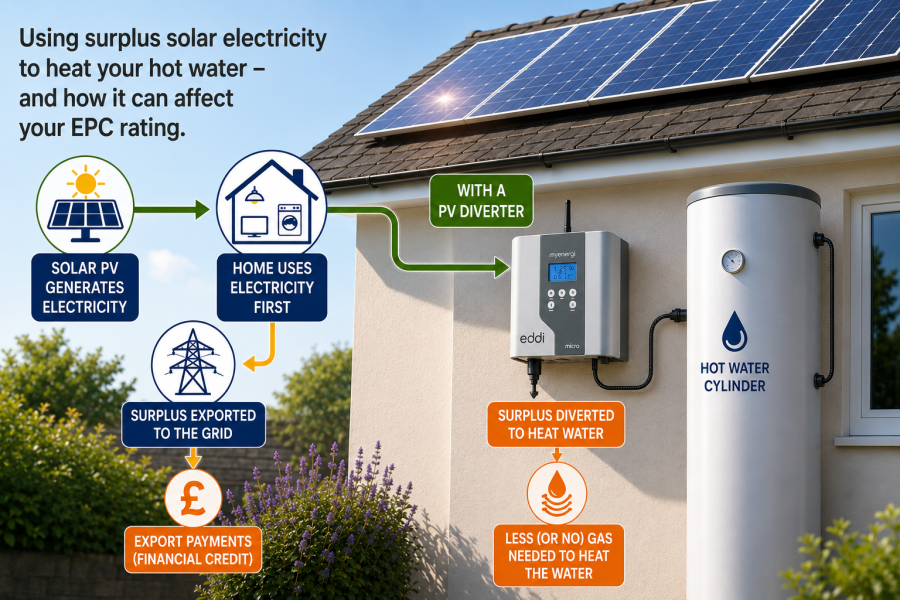 Basic schematic of a system with a solar PV diverter
At the time of writing, the methodology for EPC assessments of existing dwellings is RdSAP 10. Note that a significant methodology overhaul from RdSAP to the Home Energy Model (HEM) is proposed to start in 2027. In addition, government consultations indicate future changes to the format of EPCs and an increase in effective minimum rating levels required for private rental properties. Methods for improving EPC ratings will therefore change in the future.
At A Glance
✓ Solar PV diverters can now be recorded in RdSAP 10.
✓ They require documentary evidence of the make and model.
✓ A diverter does not always improve an EPC rating.
✓ With an export-capable electricity meter, a diverter may reduce the EPC rating.
✓ Future EPC metrics might treat PV diverters differently.
Introduction
Solar Diverters redirect surplus power from solar PV panels to heat up water stored in a hot water cylinder, rather than allowing that energy to be exported back to the national grid instead.
This means your hot water cylinder will need less contribution from your boiler or immersion heater in order to heat up the water within it.
The myenergi eddi is a well known example of a solar diverter:

Many manufacturers promote solar diverters:
- To Maximise Self-Consumption
- To Reduce Energy Bills
- To Provide Free or low-cost hot water
As we will see however, this may not be so clear cut, and in real-world cases a solar PV diverter may actually reduce your EPC rating.
How Are Solar Diverters Assessed In EPC Assessments?
The presence of a solar PV diverter could not be recorded in EPC assessments of existing dwellings prior to 15th June 2025.
Under the new RdSAP 10 methodology, solar diverters can now be recorded but there are limitations.
Methodology documentation advises that in order for a diverter to be included in the rating calculation:
- A solar PV system must be present and connected to the dwelling’s electricity supply.
- There must be a hot water cylinder with a volume greater than the calculated average daily hot water use
- There must be no solar water heating system present [ie Solar Thermal]
- There must be no battery storage system present
It also advises that:
"To maximise the diversion of electricity, a dwelling with a PV diverter may store water at a higher temperature than typical practice, also increasing cylinder heat losses – this is reflected in a correction factor of 0.9"
So for example if you also have a Solar Thermal system, or a Home Battery or a hot water cylinder that is deemed too small, then the solar diverter will not be considered in the calculation of the EPC rating.
During the assessment of an existing dwelling where a PV diverter is present, the energy assessor will take photographs of the PV diverter and related documentation the homeowner has, then select the option to indicate a diverter is present.
No details about the diverter are required in the assessment software.
The assessor however needs to comply with part of Convention 9.05 that reads:
"For PV diverters, written evidence of manufacturer and model of diverter system installed is required. If this cannot be obtained, then the diverter cannot be entered [in the assessment]"
So, if you have a PV diverter and you want the best chance of it being recorded in the EPC assessment, locate any documentation you have and present that to the energy assessor when they arrive.
When Is A Solar Diverter Presented As A Recommendation On An EPC?
A recommendation for a PV diverter is available for display on EPC certificates of existing dwellings.
Referred to as Recommendation 'U' in the documentation, it is considered when:
- PV is present, and
- PV battery storage is NOT present, and
- Solar water heating is NOT present
This recommendation is triggered when:
- A hot water tank is present
The recommendation would improve the assessment by:
- Add a PV diverter
In addition, a recommendation is presented on an EPC only if it increases the SAP rating by at least 1 (one) SAP point, or 0.5 SAP points in the case of cylinder insulation, draughtproofing and Low Energy Lighting (LEL).
Does A Solar PV Diverter Improve My EPC Rating?
Let's model the effect of a Solar PV Diverter on the EPC rating of our Case Study 1 property.
This is a 1950s mid-terrace house with a gas combi boiler. This would not be suitable in its current form because there is no hot water cylinder.
I have therefore changed the configuration of space and water heating in the assessment of this property to make it suitable for a PV diverter to be added.
For space and water heating, this property now has:
- Ideal Logic Max System2 boiler (BRE ref: 19023) with radiators, room thermostat, programmer and TRVs
- No forms of Secondary Heating
- A 'Large' hot water cylinder (i.e. greater than 170 litres)
- Water heating primarily provided by the Ideal boiler above
- Foam insulation present: 50mm thickness
- Cylinder thermostat present
For the solar we have:
- 4kWp solar capacity - single array
- 45 deg elevation
- South facing
- Overshading: Little or none
- Single rate electric meter
- Smart electric meter
- Solar array connected to the electric system
We will consider the following scenarios:
- With an export-capable electricity meter
- With a non export-capable electricity meter
THE CASE STUDY RESULTS
| Description |
EPC Rating (Export-Capable) |
EPC Rating (Non Export-Capable) |
| New Baseline - no solar, no diverter | 72C | 72C |
| With 4kWp solar, no diverter | 93A | 79C |
| With 4kWp solar, with diverter | 85B | 82B |
So, when the electricity meter is export-capable, which is the most likely scenario:
- Adding a 4kWp solar array provides a 21 point increase to 93A and there's no EPC recommendation for either a PV Diverter or a PV Battery
- But then also adding a solar diverter reduces the rating by 8 points to 85B
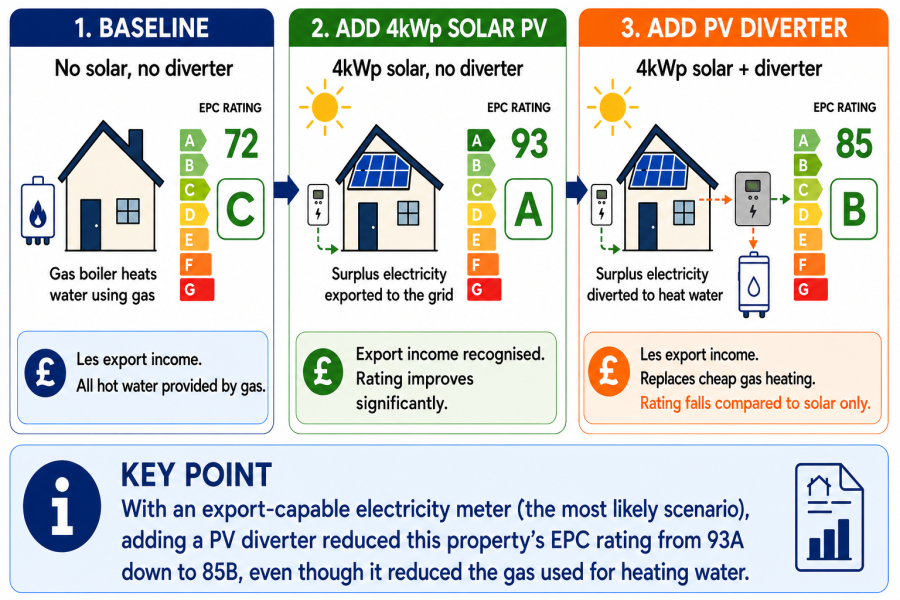
This could be seen as mildly inconvenient to a homeowner who had installed a PV diverter expecting an increase in their EPC rating.
However it does raise the question whether use of a PV diverter is a good financial use of surplus PV generation where hot water is already heated using a cheap fuel.
In comparison, when the electricity meter is not export capable, which is unlikely:
- Adding a 4kWp solar array provides only a 7 point increase and EPC recommendations are presented for a PV Diverter and a PV Battery
- Then, further adding a solar diverter provides a further 3 point increase to 82B
Notice that with a non export-capable meter, our rating only rises by 7 SAP points when we add the 4kWp solar array compared to 21 points with an export-capable meter.
The difference is because without an export-capable meter, any surplus solar generation cannot be exported to the grid, and is not utilised.
The pattern with the non export-capable meter is similar again, although adding the diverter gives a larger increase than the example with a gas boiler.
I repeated the testing with a main heating system consisting of electric panel heaters. The results were almost the same, although the ratings were much lower because electric panel heaters are more expensive to run than a gas combi boiler.
Background Information: Fuel Costs In EPC Assessments
The headline EER rating on domestic EPCs is a cost based metric.
The fuel costs used in the rating calculation of existing dwellings are therefore of significant interest.
Here are those costs for the most common electricity tariffs plus mains gas:
| Fuel Type |
Fuel Cost (p/kWh) |
| Standard Tariff (Single Rate) | 13.19 |
| 7 Hour Tariff (High Rate) | 15.29 |
| 7 Hour Tariff (Low Rate) | 5.50 |
| Electricity sold to grid, PV | 13.19 |
| Electricity self-used, PV | 13.19 * |
| Main Gas | 3.48 |
* ...or a weighted average of the low and high rates in the case of dual rate electricity.
(separate fuel costs are used for the financial values quoted on an EPC)
For existing dwellings, the financial value given to excess solar generation exported to the grid is still equal to the cost of single rate electricity drawn from the grid.
There is therefore no/little perceived differential in financial value between exporting excess solar to the grid and drawing it back again later, versus using that solar power in the home straight away.
These things contributed to the observations about Home Batteries, and will also contribute towards how Solar PV diverters are valued in EPC assessments of existing dwellings.
The situation is different in SAP (for new builds) where there has been a differential since 2022 between the value of exported excess solar generation, versus the cost of single rate electricity drawn from the grid (i.e. there is not so much of a financial benefit in exporting excess generation).
Something else to bear in mind is that the methodology does not have a data entry point for the DNO export limit for the property. Therefore all surplus generation is assumed to be exported.
Why Are The Results Not What I Expected?
Initially I was surprised at the results.
I'm only interested in the scenario where the electricity meter is export capable, because this would be expected with a solar PV installation.
Looking deeper at the scenario, there are two financial aspects at play here:
- The financial balance of using that surplus PV generation to heat water in a hot water cylinder, instead of exporting it to the grid.
- The financial balance of heating that water in the hot water cylinder using surplus PV generation instead of heating it using the method you would have used otherwise.
Applied to our example property, this means:
Without a PV diverter, all surplus PV generation would have been exported to the grid and rewarded financially at 13.19 p/kWh. Also, in our example property the hot water would have been heated by the mains-gas system-boiler at 3.48 p/kWh.
However, when a PV diverter is installed, surplus PV generation is used to heat water in the cylinder instead of gas. You therefore lose the 13.19 p/kWh financial reward because it's not earning that money any more, and you replace the water heating previously costing 3.48 p/kWh with electricity that's effectively worth 13.19 p/kWh.
The difference in value of those fuels (13.19-3.48=9.71 p/kWh) is significant and for the most part is why the rating drops.
(Admittedly, there are many other aspects such as boiler efficiency and cylinder heat loss at the higher temperature required with a PV diverter that should really be taken into consideration but for simplicity we've ignored those)
Key Takeaways
✔ Solar PV diverters can now be recorded in RdSAP 10.
✔ Documentary evidence of the make and model is normally required.
✔ A diverter does not automatically improve an EPC rating.
✔ With an export-capable electricity meter, a diverter may reduce the EPC rating.
✔ The effect depends on the property's heating system and export arrangements.
✔ Future Home Energy Model methodology may produce different results.
✔ Always consult a local Domestic Energy Assessor (DEA) before making any changes to your property.
✔ Whether a PV diverter is worthwhile depends on your heating system, electricity export arrangements and your priorities.
Click here to return to our 'Improve Your EPC' main page, and see if there is another way you could improve your EPC rating.
 Print
Print 