
Cavity Party Wall Insulation
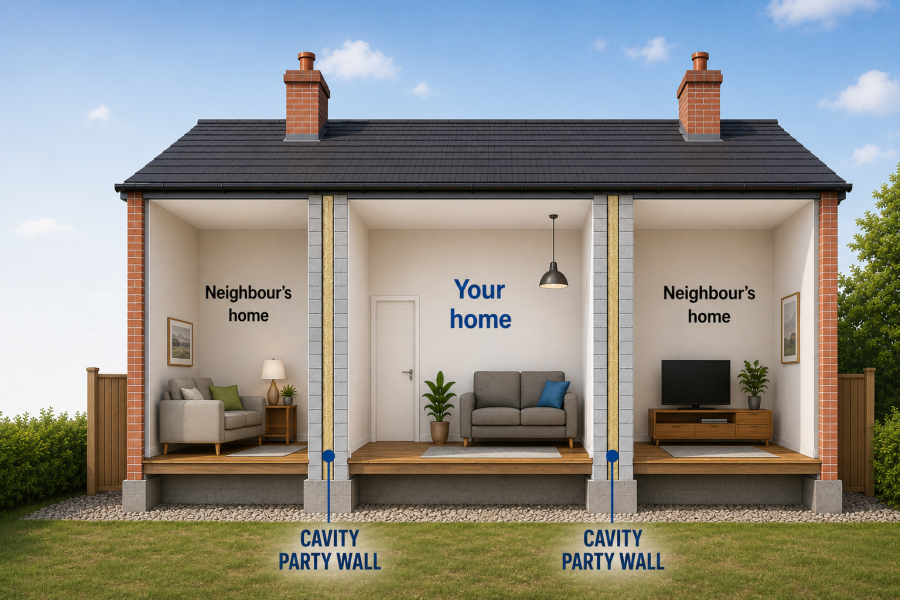 A cavity party wall separates two adjoining dwellings. But party walls can be constructed in several different ways.
At the time of writing, the methodology for EPC assessments of existing dwellings is RdSAP 10. A significant methodology overhaul from RdSAP to the Home Energy Model (HEM) is proposed for 2027. In addition, government consultations indicate future changes to the format of EPCs and minimum rating levels required for private rental properties. Methods for improving EPC ratings will therefore change in the future.
At A Glance
In this article, you'll learn:
- What a party wall is and the different ways it can be constructed.
- How an energy assessor identifies the type of party wall.
- How different party-wall constructions are treated in RdSAP.
- How Convention 2.24a can affect the classification of a party wall.
- Whether insulating a cavity party wall can improve your EPC rating.
- Why the potential improvement varies considerably between properties.
Introduction - What Is A Party Wall?
When the subject of insulating walls is discussed, it's almost always in the context of external walls of a property.
However, if your property is attached to another, such as in the case of a terraced house or a semi-detached house, then the wall(s) both properties share in common is called a Party Wall.
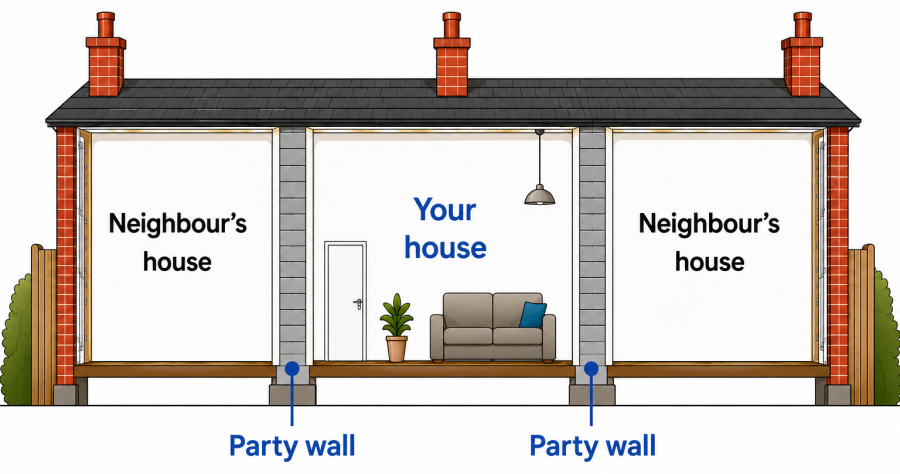
During an EPC assessment, the type of party wall is recorded, and in some cases insulating this party wall can improve your EPC rating.
Aren't All Party Walls The Same?
No, there are different ways a party wall could be constructed:
Solid Party Walls
In older properties it is common for the party wall to be solid masonry, ie solid brick or block all the way through to your neighbour on the other side.
Cavity Party Walls
More recently, party walls have often been constructed in the form of a cavity wall. This commonly has two leaves of block wall separated by a void, called a cavity, between them.
Timber Framed Properties
With modern timber-framed properties, the party wall may also be constructed using timber framing. These may also have features that reduce any potential spread of fire or smoke.
System Build
System build encompasses a variety of construction methods using pre-manufactured components assembled on site. Examples include Cornish Units, Airey construction and more modern systems such as Insulated Concrete Framework (ICF).
Don't assume that a party wall is a cavity wall.
Party walls can be constructed in several different ways. An assessor may be able to determine the construction from inspection of the loft, but this isn't always possible definitively.
How Are Party Walls Recorded In An EPC Assessment?
The assessor identifies which (if any) walls at the property are party walls.
The length of party wall and the ceiling height is recorded where applicable, for each storey in each building part (main building plus any extensions).
The party wall type is then selected for each building part from this list:
- Solid masonry/Timber Frame/System Built
- Cavity masonry unfilled
- Cavity masonry filled
- Unable to determine
This is the only option related to the party wall type available. The U-value cannot be overridden, and there are no further options to record the presence or thickness of insulation.
How Is The Party Wall Type Determined?
In the case of a typical house, energy assessors normally deduce the construction type of the party wall by looking in the loft.
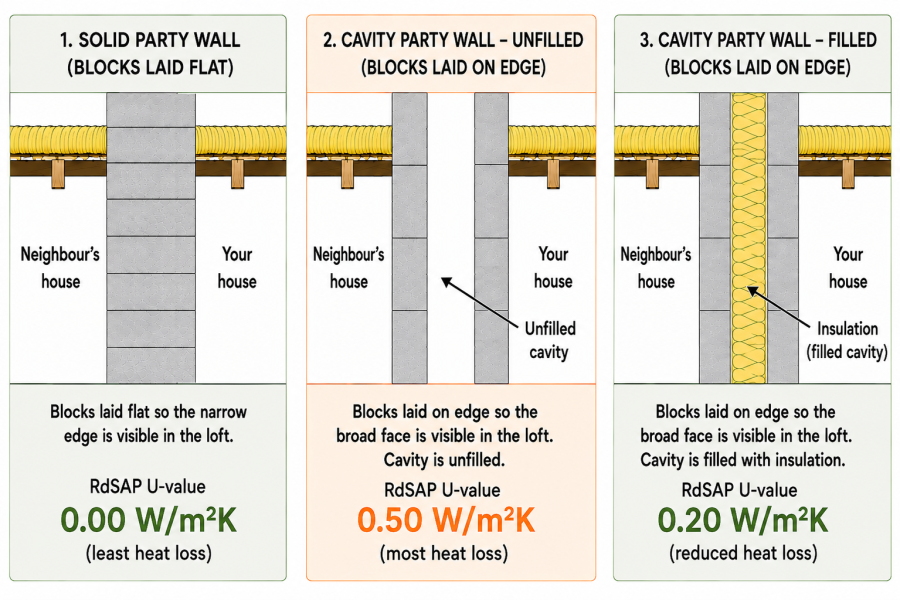
The triangular upper part of the party gable wall, visible in the loft, gives clues to the type of construction.
This diagram shows three common types (we'll come to U-values shortly):
Solid Masonry Party Walls
If the party wall is constructed from blocks laid flat, with the narrow edge of the blocks visible in the loft, this would indicate a solid masonry party wall. Traditional brickwork showing headers as well as stretchers would also indicate solid masonry construction.
Masonry Cavity Party Walls
Building blocks laid on edge with their large face pointing into the loft might ordinarily indicate a cavity party wall, however further information like the wall thickness is then required to confirm this, and a search is made to see if there is evidence of cavity wall insulation fill holes. The same is also the case where stretcher bond brickwork is present instead.
Wall Thickness & Insulation Fill Holes
If the wall is suspected to be a cavity wall due to the way the blocks have been laid, the assessor looks for any evidence of cavity wall insulation fill holes. If a pattern of such holes is evident, the wall is recorded as "Cavity masonry filled".
If no such fill holes are visible, then the assessor determines whether it's possible to measure the thickness of the wall. This is a bit tricky considering the extent of their responsibility is only a 'head and shoulders above loft hatch' approach.
If the thickness of the wall can be measured and is sufficient to establish it is a cavity wall, the assessor records it as 'Cavity masonry unfilled'.
RdSAP Convention 2.24a
If the wall is suspected to be a cavity wall, but it's thickness cannot be measured, and there is no other specific evidence of construction, Convention 2.24a (introduced on 1st January 2024) directs assessors how to record the wall:
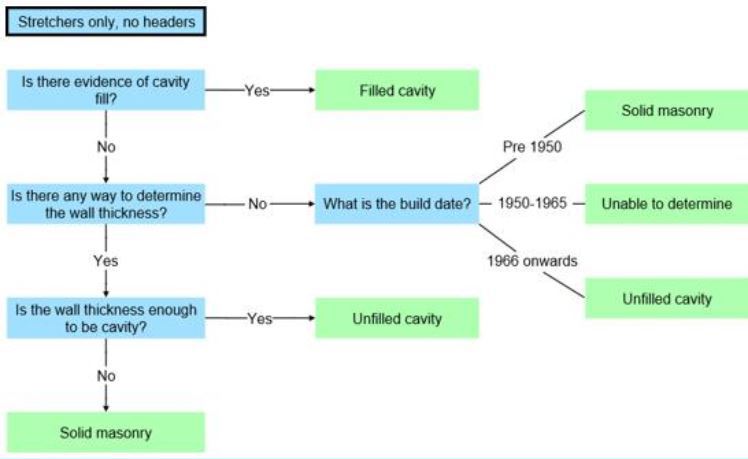
In this scenario, the construction age of the property determines the party-wall classification:
- Pre 1950 = Solid Masonry
- 1950-1965 = Unable to determine
- 1966 onwards = Unfilled cavity
Previously, an assessor would have chosen 'Unable to determine'. This leads to a difference in how some party walls were assessed for EPCs issued prior to 2024 and from 2024 onwards.
Timber Framed Party Walls
Modern timber framed buildings may have masonry party walls, but they could instead have timber framed party walls. These would be evident by the presence of vertical timber studs, horizontal noggins and sheet material applied to the studs.
Documentary Evidence
This might be necessary where a masonry party cavity wall has had insulation retrofitted, but the fill holes are only present on the other side of the wall and therefore not visible to the property that is being assessed.
Multiple Construction Types In A Party Wall
It's possible for a party wall to be built using one construction method on the first and ground floors of a house, but then the triangular section that's visible in the loft to be built using a different construction method.
It could for example be an unfilled cavity wall up to first floor ceiling level and then solid masonry party wall in the loft.
This may not be possible to notice from just a 'heads and shoulders through the loft hatch' assessment.
How Do Party Walls Contribute To Heat Loss In EPC Assessments?
Heat loss through elements of building fabric are represented by a U-value in the calculation of the EPC rating.
With party walls, the U-values are as follows:
| Party Wall Type |
U-value (W/m2K) |
| Solid Masonry / timber frame / system built | 0 |
| Cavity masonry unfilled | 0.50 |
| Cavity masonry filled | 0.20 |
| Unable to determine (house or bungalow) | 0.25 |
| Unable to determine (flat or maisonette) | 0 |
The information in the table above is from Table 15 in the RdSAP 10 Specification Document on the BRE website.
Unlike external heat-loss walls, the RdSAP party-wall U-value is only determined by the party-wall type. The age band of the dwelling is not relevant.
Notice that solid masonry party walls are assumed to have zero heat loss to the neighbouring property (the U-value is zero).
In the past it was also assumed that cavity party walls had zero heat loss, but research into the thermal performance of cavity party walls has since shown heat transfer to the cavity, including convection, needs to be accounted for in the modelling.
Previous EPC Recommendations For Party Wall Insulation
In an earlier version of assessment methodology (v9.93), a recommendation was introduced whereby if an unfilled cavity party wall was declared, a recommendation could appear on your EPC advising to have that cavity party wall insulated.
This would appear if the measure increased the EPC rating by at least 1 SAP point.
That recommendation however was removed from the methodology when it was updated to version 10 in June 2025.
The recommendation used to appear like this:
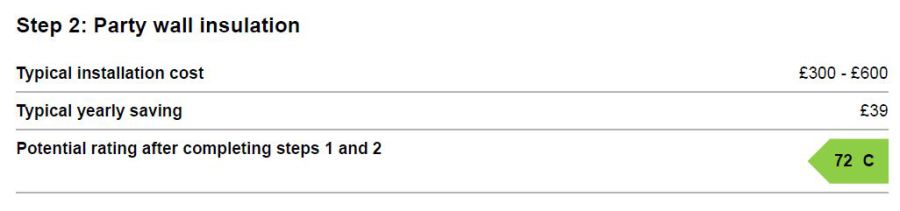
The absence of this recommendation nowadays doesn't mean that cavity party wall insulation no longer has any effect on the EPC calculation.
It just means that RdSAP 10 no longer generates that recommendation.
This distinction is important.
Does Party Wall Type Affect The EPC Rating?
For my property, a 1950s double-fronted mid-terrace house, party wall type has the following effect on my EPC rating:
| Party Wall Type | My EPC Rating |
| Cavity, masonry unfilled | 67D |
| Unable to determine (house) | 68D |
| Cavity, masonry filled | 68D |
| Solid Masonry / timber / System build | 69C |
So for my property it doesn't make much of a difference.
From 'Unable to determine' (which the new convention instructs me to declare) to 'Cavity masonry filled', there is no improvement to the integer value of my EPC rating. This is partly due to the U-value only chaning from 0.25 to 0.20, a difference of only 0.05 W/m²K.
My property, although being a mid-terraced property and therefore having two party walls, is also not very deep, so those party walls are not very long. The house is fairly wide instead.
For a house that is instead fairly narrow, and deeper, and therefore has longer party walls, the difference can be greater.
Consider for a moment a mid-terraced property that is fairly narrow and deep, and constructed from 1966 onwards.
You might have a previous EPC issued before Convention 2.24a was issued, and under that EPC the assessor was allowed to declare the party wall as 'Unable to determine' (U=0.25). You produce a new EPC, the assessor has to follow Convention 2.24a and the party wall is described instead as 'Cavity - Masonry unfilled' (U=0.50).
I assessed a property just like this. The EPC rating had not gained as many points as the landlord had expected from the improvement measures he had implemented so I looked at the party wall type to see what effect Convention 2.24a had on the new EPC rating. This was under RdSAP 9.94 at the time:
| Description | EPC Notes (Property 2) |
| Party Wall: Unfilled Cavity | -3 compared to 'Unable to determine' |
| Party Wall: Filled Cavity | +4 compared to 'Unfilled Cavity' |
So on that property, the rating was three points lower than it would have been had I still been able to declare the party wall as 'Unable to determine'.
Then, if party wall cavity insulation was subsequently installed, this measure would add 4 points to the rating.
Although the costs and effort required with neighbours to implement party wall cavity insulation might be high, it might be worth checking the cost.
As always, check with a local energy assessor what difference party wall cavity insulation might make to your EPC rating, before going ahead with any works.
EPC ratings are calculated using all information gathered during assessment of your specific property.
What About My Neighbour?
Installing cavity party wall insulation may require agreement or consent and the legal position can depend upon exactly what work is proposed.
GOV.UK says that work on an existing party wall or party structure can fall within the Party Wall etc. Act 1996 and that owners should notify adjoining owners where applicable.
Is A Cavity Party Wall Worth Insulating?
This needs to be discussed with a domestic energy assessor, because:
- It may be worthwhile thermally
- It may improve the EPC rating
- The improvement may be modest
- The effect depends heavily on the area of party wall and the dwelling characteristics including construction date
- It may be difficult to arrange, particularly where neighbour cooperation is required.
- It should not be regarded as an automatic "improve your EPC" measure
Key Takeaways
- Not all party walls are cavity walls. They may be solid masonry, cavity masonry, timber framed or system built.
- The construction of the party wall matters for the EPC. RdSAP assigns different U-values to different party-wall types.
- The construction visible in the loft can provide important clues, but it isn't always possible to establish the party-wall construction conclusively from a loft inspection alone.
- Convention 2.24a changed the way some party walls are recorded. Where the construction cannot be established and there is no other specific evidence, the property's age can determine the classification.
- Cavity party wall insulation can improve an EPC rating, but the improvement varies considerably between properties. The area of party wall and the characteristics of the dwelling can make a substantial difference.
- The removal of the party-wall insulation recommendation from RdSAP 10 doesn't mean that the measure has no EPC effect. It means only that RdSAP 10 no longer generates that recommendation.
- Don't assume that party wall insulation will be worthwhile simply because the RdSAP U-value changes. Check the likely effect on the particular property's EPC before committing to any work.
Return to our 'Improve your EPC rating' page to see if there are any other measures you could implement.
 Print
Print 