
Home Batteries
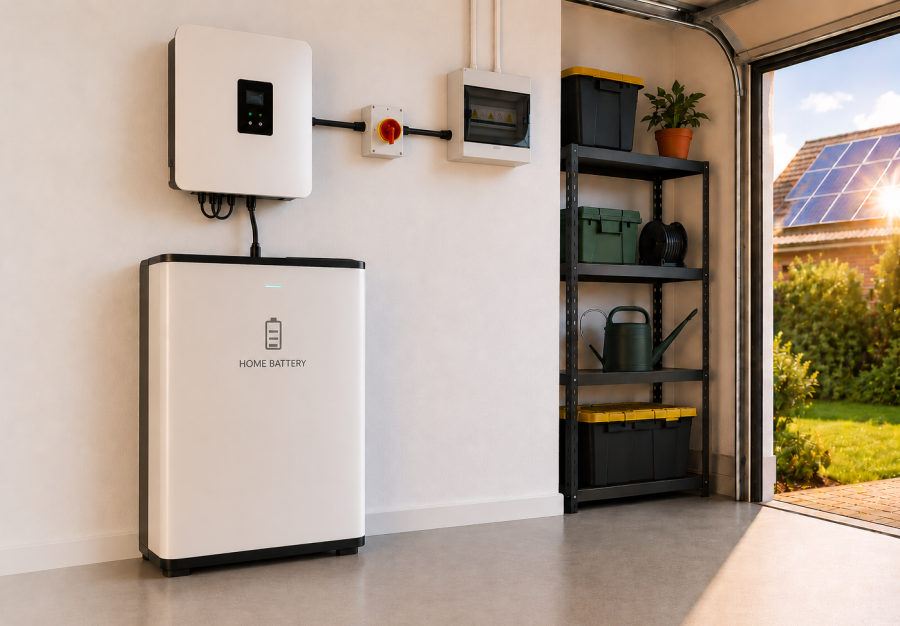 Modern home battery connected to a hybrid inverter in a domestic garage
At the time of writing, the methodology for EPC assessments of existing dwellings is RdSAP 10. Note that a significant methodology overhaul from RdSAP to the Home Energy Model (HEM) is proposed for 2027. In addition, government consultations indicate future changes to the format of EPCs and minimum rating levels required for private rental properties. Methods for improving EPC ratings will therefore change in the future.
At A Glance
On this page you'll learn:
✔ Home batteries are now recordable in RdSAP 10
✔ How home batteries are recorded in EPC assessments
✔ When a recommendation appears for a home battery
✔ Whether home batteries improve the EPC rating
✔ How electricity meter export-capability status is involved
What Are Home Batteries?
Home batteries allow you to store electrical energy at your property, and then consume it at a later time.
This could be surplus electricity generated by your solar panels, which you choose to store rather than export to the grid. You can then use that stored electricity later when your solar generation is less than your household load.
Alternatively it could be electricity drawn from the national grid during the night when you have cheap rate electricity available. You can then consume that stored electrical energy during the day when it would be more costly to have drawn it from the national grid instead.
It's also possible for any spare power in the home battery to be exported back to the National Grid for financial reward.
Home batteries are often fitted in combination with solar photovoltaic panels, but they can be fitted on their own and used simply for load shifting (i.e. charging at night and consuming during the day).
How Are Home Batteries Recorded In An EPC Assessment?
The assessment methodology for existing dwellings (RdSAP) did not support the recording of home batteries until 15th June 2025.
Since then, home batteries are now recordable, but there are some significant limitations in their modelling.
Firstly, the guidance in RdSAP 10 Convention 9.05, instructs energy assessors that:
"For PV batteries, photographic or written evidence of manufacturer and model of battery unit used, and usable capacity (kWh) is required. If this cannot be obtained, use a default of 5kWh per battery."
So the battery and it's capacity needs to be positively identified.
Also, the maximum recordable size of a battery is 5kW, but assessors can record multiple batteries to match the capacity of a single larger battery.
For example, if the battery had a capacity of 13.5kWh then this can be represented by declaring three batteries such as 5kWh + 5kWh + 3.5kWh.
However, only a maximum of four batteries can be recorded in an assessment, and the maximum combined total recordable capacity is 15kWh.
For most installations this is likely to be fine, but it's not uncommon for an installation to be greater than 15kWh.
Next, the following 'Addenda' is enabled in the assessment when a Home Battery is fitted but Solar PV is not:
Addenda 16 - PV-independent battery storage present - This results in the following text being added to the final EPC: "The assessment does not include PV-independent battery storage"
This confirms that a home battery, in the absence of solar PV, is not considered in the rating calculations.
Any potential benefit of 'load shifting' of grid supplied energy is not modelled.
In reality a home battery in this situation could help save energy costs by charging from the grid during the night when low cost electricity is available and allowing the house to consume that electricity during the day when it would be more expensive to draw from the grid instead.
This however would be down to how an occupant uses the home battery, and EPC assessments need to be as much about the property as possible rather than how a particular occupant uses it.
Lastly, documentation of the underlying SAP 10.2 methodology indicates the capacity of a home battery is only used to calculate an increassed self-use factor for solar PV generated electricity.
When Does A Recommendation for a Home Battery Appear On An EPC?
The RDSAP 10 Specification document lists a new EPC recommendation as being available for a home battery:
- This recommendation will be considered when the dwelling currently has solar PV present
- This will be recommended if the dwelling has solar PV present but not battery storage.
- The recommendation will suggest the installation of a single 5kWh battery
In addition, EPC recommendations only appear if they increase the SAP rating by at least 1 SAP point, or 0.5 SAP points in the case of cylinder insulation, draughtproofing and Low Energy Lighting (LEL).
As we will discover on this page, this recommendation is only likely to appear in the case where the electricity meter is not export capable.
By How Much Does A Home Battery Improve An EPC Rating?
I'm interested in what EPC rating improvement I could expect on my Case Study 1 property when a home battery is added.
We discovered earlier that home batteries are only considered in the RdSAP methodology if solar PV is also present.
Therefore we've added solar PV to this property in the assessment, and we've obtained the following baseline results, with a single-rate electricity meter:
| Description | EPC Rating |
| Baseline (no solar PV) | 74C |
| 2.5kWp Solar - Not Export Capable | 79C |
| 2.5kWp Solar - Export Capable | 87B |
From here, we'll stick with an export-capable single-rate meter, and add a home battery and see what rating improvement we get.
The battery is 15kWh:
| Description | EPC Rating |
| Baseline (no solar PV) | 74C |
| 2.5kWp Solar | 87B |
| 2.5kWp Solar + 15kWh Battery | 87B |
The results for this property are:
- When solar PV is not present, and the electricity meter is export capable, the rating does not improve when a home battery is added
- When solar PV is present and the electricity meter is export capable, you get the same EPC rating regardless of whether a home battery is present or not.
So, in a normal scenario where you would have an export capable electricity meter (who woudn't if they had solar PV?) my EPC rating doesn't change at all when a home battery is added.
This would be mildy inconvenient if I'd just purchased a home battery expecting an increase.
So why do I not get an increase in EPC rating?
Well, this is due to the electricity fuel costs used in the RdSAP methodology which we will discuss shortly.
However, let's consider the case where the electricity meter is again single rate but is not export capable as this is slightly different:
| Description | EPC Rating |
| Baseline (No solar) | 74C |
| 2.5kWp Solar | 79C |
| 2.5kWp Solar + 15kWh Battery | 86B |
This is an unlikely situation where solar PV is present but an electricity meter is not export capable, however presence of the battery clearly does make a significant difference, ensuring a greater proportion of surplas solar generation is self-used.
In this case however it doesn't quite bring the rating fully up to the level it would have been had the meter been export capable.
In summary, at the moment, addding a home battery will only really improve the EPC rating if you also have solar PV present, and your electricity meter is not export capable.
On the face of things, that might come across as a very strange statement to make because you'd rightly expect all properties that have solar installations to also have export capable electricity meters as standard, and you'd also expect the presence of a home battery to provide a financial benefit to the property that would be reflected in the EPC rating beyond just having the solar installation on its own.
Why Does The EPC Rating Not Improve With A Home Battery (And An Export Capable Meter)?
We've noticed the EPC rating does not improve when a home batery is added, in the case where solar PV is already present, and the electricity meter is export capable.
The root cause of this is the fuel prices used behind the scenes in the RdSAP methodology.
Two sets of fuel prices ('fuel costs') are used in the producion of a domestic EPC.
One set is used in the calculation of the headline EPC rating, and the other is used for the indicated running costs shown on the EPC, and also the financial improvement figures for EPC recommendations.
The first set are static and rarely changed, perhaps only when a significant methodology update occurs.
The second set however are updated every 6 months in order that the cost figures on EPCs remain representative.
We're going to look at that first set of fuel costs, and from this paragraph onwards we'll simply call them 'fuel costs', and not distinguish them from the second set described above.
In addition to fuel costs, we'll also consider assessment methodologies, two of which are used in the production of EPCs for domestic properties:
- SAP (Standard Assessment Procedure) - this is the assessment methodology used for new-build dwellings.
- RdSAP (Reduced Dataset Standard Assessment Procedure) - This is the assessment methodology used for existing dwellings.
RdSAP actually uses SAP as its base methodology, but translates a reduced set of assessment data into the more detailed data that's required by SAP.
SAP is currently at version 10.2 and was updated in 2022 from the previous version SAP 2012, at which time fuel costs in the methodology were updated as part of the changes.
RDSAP is currently at Version 10.0.1 (based on SAP 10.2), but it was updated later, in June 2025, from version 9.94 (based on SAP 2012), but the fuel costs in RdSAP 10 were kept the same as they were in RDSAP 9.94. They were not updated to match those currently used in SAP 10.2.
This clearly followed deliberation whilst the RdSAP update was delayed for various reasons including a general election.
For reference, the fuel costs can be viewed in:
- Table 12 of the SAP 2012 documentation on the BRE website. These fuel costs were used by SAP 2012 and RDSAP 9.94.
- Table 12 of the SAP 10.2 documentation. These are the fuel costs used by SAP 10.2
- Table 31 of the RDSAP 10 Specification document. These are the fuel costs for the current version of RDSAP.
Let's take a quick look at these fuel costs, and these reveal what's happening.
Here are the main relevant electricity prices for single rate electricity, dual rate electricity and electricity exported to the grid.
To keep the table simple, I've omitted other, lesser used, electricity tariffs and information about standing charges etc.:
| Electricity Tariff |
RdSAP 10 (p/kWh) |
SAP 10.2 (p/kWh) |
| Standard Tariff (Single rate) | 13.09 | 16.49 |
| 7 Hour Tariff (High rate) | 15.29 | 19.60 |
| 7 Hour Tariff (Low rate) | 5.50 | 9.40 |
| Electricity sold to grid, PV | 13.19 | 5.59 |
You'll notice overall that unit rates are rather low compared to actual electricity costs in 2026, particularly for RdSAP.
For example, typical unit prices for single rate electricity in 2026 are probably around 24 p/kWh, so 13.19 and 16.49 are rather less than that, but in itself this is not too important. The ratio of one fuel cost versus another is more important.
Notice in the table that for RdSAP 10, surplas electricity exported to the grid from solar PV generation is still valued equally with electricity imported from the grid on a single rate tariff (13.19p/kWh).
This is the reason that Home Batteries make no difference to the EPC rating for existing dwellings.
It makes no financial difference to the methdology whether surplas solar PV generation is exported to the grid, or stored for self-use at a later time.
There is no financial cost benefit in storing the energy, and the EPC rating for domestic properties is a cost-based metric.
It's slightly different for new-builds. Notice the value of excess electricity exported to the grid from solar in SAP 10.2 (at 5.59 p/kWh), is much lower compared to the single rate import unit price (of 16.49 p'kWh).
This could lead one to expect a diversion of comparative EPC ratings between SAP and RdSAP when home batteries and solar are present. However, with the new HEM methodology and EPC reform on its way, with multiple metrics replacing the current cost-based metric, this is unlikely to become a major issue (phew!).
Just to complete the picture in relation to solar and home batteries, the methodologies both consider self-consumed electricity from solar generation as having the same value as electricity drawn from the grid. This is the single tariff rate when a single rate meter is present or a weighted average of the low and peak rates when a dual rate meter is used.
Looking back at that decision to keep the fuel costs the same from RDSAP 9.94 through to RDSAP 10, this choice will have contributed significantly to maintaining the consistency of EPC ratings of existing dwellings when new EPCs are conducted (subject to other changes in methodology of course).
This is because the EPC rating for domestic properties is cost-based.
That decision however also baked-in the effect where home batteries, which are now recordable under RDSAP 10, are unlikely to improve your EPC rating unless your electricity meter is not export capable which is an unusual scenario.
Will Home Batteries Be Modelled Differently In The Future?
Following government consultations, their intentions to change the methodology for domestic EPCs in the future are clear.
The current proposals for England & Wales are for a multi-metric EPC format with 4 metrics.
The relevant one for Home Batteries will be the 'Smart Readiness' metric.
To obtain a 'C' in this metric, the documentation indicates a smart meter and a level of solar PV will likely be required but other aspects such as home batteries will also contribute.
As we approach late 2027 we will have more information on how the new Home Energy Model will work.
Key Takeaways
✔ Home batteries are usually installed to reduce electricity costs and increase energy independence, rather than to improve EPC ratings.
✔ Installing a battery without solar PV is ignored by the current RdSAP methodology, even though it may still reduce running costs through energy arbitrage.
✔ If solar PV is present and the electricity meter is export capable, then adding a home battery will not increase the EPC rating on its own.
Return to our Improve Your EPC Rating page and see if there is anything else you can do.
 Print
Print 