
Solar PV (Photovoltaics)
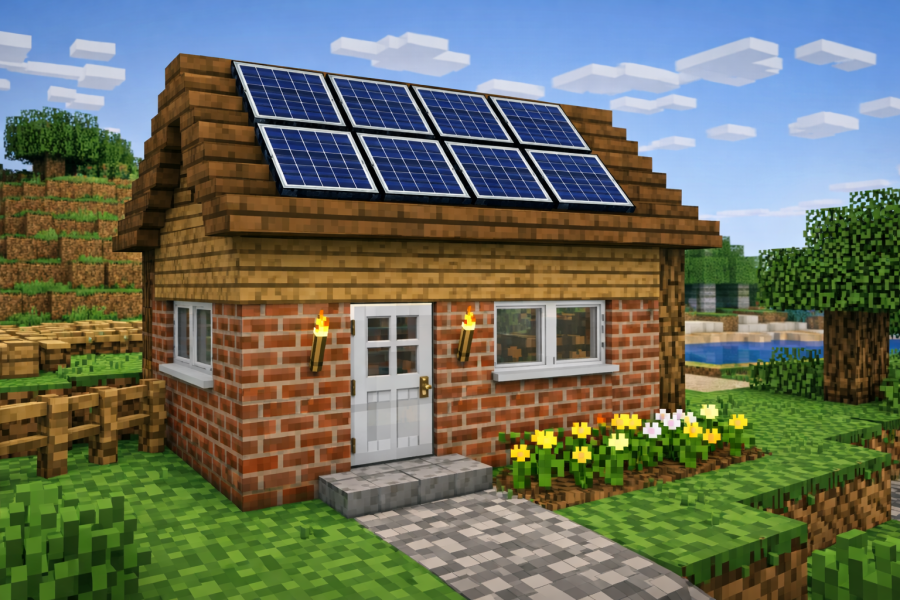 A House With Solar PV
At the time of writing, the methodology for EPC assessments of existing dwellings is RdSAP 10. Some of the information in this page refers also to RdSAP 9.94, and clarity is given in each case. Note that a significant methodology overhaul from RdSAP to the Home Energy Model (HEM) is proposed for 2027. In addition, government consultations indicate future changes to the format of EPCs and minimum rating levels required for private rental properties. Methods for improving EPC ratings will therefore change in the future.
At A Glance
On this page you'll learn:
✔ About solar PV
✔ How solar PV is recorded in EPC assessments
✔ When an EPC recommendation appears for solar PV
✔ The significance of electricity meter export capability status in the EPC assessment
Solar Photovoltaic (PV) Panels
Solar photovoltaic (PV) panels capture the sun's energy and create electrical power.
This provides a source of 'free', renewable, 'clean' electricity which you can use towards powering appliances in your home, therefore reducing the amount of electricity you draw from the National Grid, and reducing the cost of your electricity bill.
In addition, any excess power you generate can be stored in a Home Battery, or exported out to the National Grid for a financial return.
The presence of photovoltaic panels on a dewlling will help improve your EPC rating, and they are becoming a popular energy upgrade.
Solar panels are useful for generating power during the day when the sun shines, and more so in the Summer compared to Winter.
This contrasts to wind as a source of electricity generation which is comparitively more consistant over a day, and is plentiful in the Winter compared to the Summer, although rarely used in a domestic environment.
Together, these two sources of power are now contributing significantly to electricity generation at a national level, as can be see on the historical graphs of the GB Energy Dashboard here: https://www.energydashboard.co.uk/. This has enabled us to move away from less green fuel sources such as coal.
(Ratcliffe-on-Soar, the last remaining coal-fired power station in the UK, closed on 30th September 2024, marking the end of a 142-year history of coal-powered electricity generation in the UK).
Solar Photovoltaic vs Solar Thermal
This page is about Solar Photovoltaic panels, but there is another type of Solar panel that you may occasionally come across called Solar Thermal panels, and these are quite different.
Solar Thermal panels contain pipes in which water is heated by the sun and circulated to heat up water stored in a Hot Water Cylinder for use in baths, showers, basins and sinks in the home.
Solar Thermal panels have fallen out of favour in recent years, with preference now generally given to Solar PV panels instead due to the flexibility of use of the generated electricity and the reduction in costs of solar panels in recent years.
 Example roof containing Solar Thermal and Solar Photovoltaic panels
By way of example, the photo above is a property I walk past four times a day during school drop-offs and pick-ups.
In the centre of the roof is a solar thermal panel. You would normally only see one or two of these in such an installation.
The two blocks of 3 panels located either side, are solar photovoltaic panels.
In the case of this installation, they have been limited in size by the presence of the Solar Thermal panel and the two other rectangles on the roof, which are 'Velux' style windows.
Is Solar PV Available For Heritage Buildings?
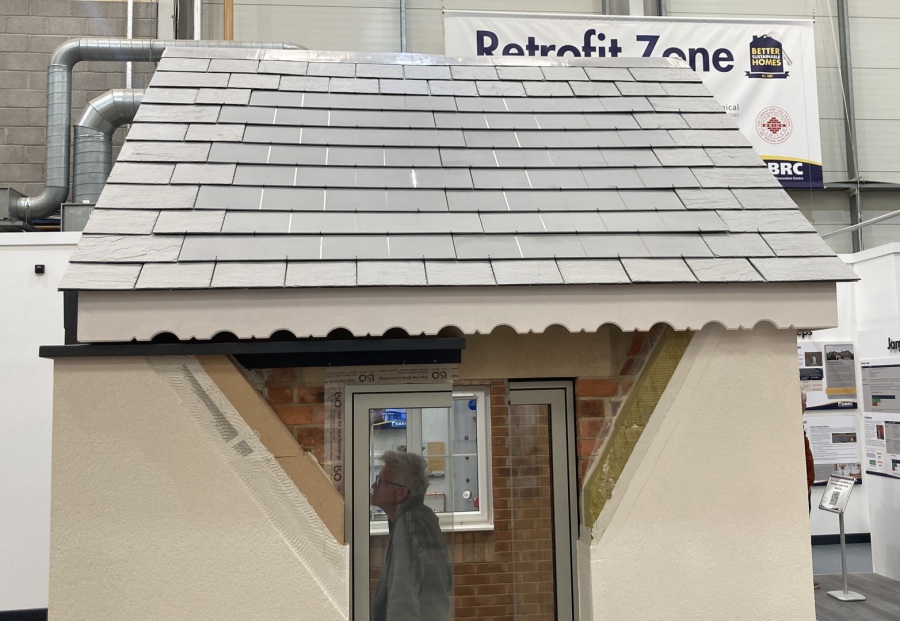
I almost completely missed this solar PV product on display at the National Self Build and Renovation Centre (NSBRC) in Swindon.
The main part of the display demonstrates external wall insulation, but the mock-up roof features integrated solar PV panels disguised as slates.
This product is called 'PV Slate' and could be suitable for heritage buildings or aesthetically sensitive sites.
This type of product could easily be missed by an energy assessor in a hurry unless they spotted an inverter or generation meter in the property:
When Does An EPC Recommendation Appear for Solar PV?
Solar Photovoltaic panels are often listed as a recommendation on domestic EPCs as an improvement measure, and the gains can be significant.
The recommendation is triggered when:
- The property is a House or a Bungalow
- The property does not have a thatched roof
- Solar PV is not currently present at the property
The improvement measure used to generate the higher EPC rating is:
- A single 2.5 kWp solar PV array, South facing, 30° pitch, modest overshading, connected to dwelling’s electricity meter
The recommendation will not appear for flats, masionettes, thatched properties or where solar PV is already present.
There is no mention in the improvement measure of whether the electricity meter is export cabable or not. The improved EPC rating will therefore be calculated using the export capable status of the electricity meter in the current assessment. If this is currently not export capable, the improved rating will be lower than if the meter was export capable. We cover export capable meter status later in this page.
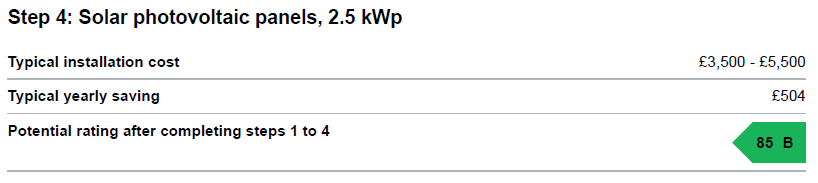 EPC Recommendation For Solar PV
The recommendation shows the potential improvement with 2.5kWp of solar PV, although you are free to install as much as your property can accommodate.
Recommendations appear on EPCs when the improvement measure increases the EPC rating by at least 1 SAP point, or 0.5 SAP points in the case of Low Energy Lighting, Draught Proofing and Hot Water Cylinder Insulation.
For Solar PV the benefit in rating is normally much more than 1 point.
Solar PV panels don't have to be accommodated on the roof, and there are various ground and wall mounting solutions available which may widen the range of properties where they are approriate.
What Is The Microgeneration Certification Scheme (MCS)?
MCS is the UK's main quality assurance and certification scheme for small-scale renewable energy systems and their installers.
It provides confidence that renewable energy products have been installed safely, correctly and to recognised standards.
Most solar PV installations will have been conducted by an installer certificed under the Microgeneration Certification Scheme (MCS), and a certificate provided to the owner on completion.
The MCS website indicates that in order for an MCS certificate to be made available, an installation must:
- Be commissioned by an MCS certified Installation Company
- Include an MCS certified product
- Have a commissioning date after 15th July 2009
The MCS certificate is very useful documentary evidence that can be used to include the installation in an EPC assessment.
An MCS certificate is actually not a mandatory or legal requirement for a solar installation, but it is normally regarded by energy suppliers as the pre-requisite for Smart Export Guarantee (SEG) eligibility where you get paid for any excess generation you send back to the national grid.
Therefore most people seeking installation of solar PV will use an installer registered with MCS.
How Is Solar PV Recorded During An EPC Assessment?
There are two methods by which Solar PV can be considered in an EPC assessment of an existing dwelling. They are:
- Documentary Evidence
- Percentage of Roof
In either case, the energy assessor will take photographs of any available documentation, the roof of the property and the panels.
They will also want to photograph a generation meter, and possibly further visually evidence that the installation is connected to the electricity meter of the dwelling.
Since the 15th June 2025 they will also want to determine whether the electricity meter is a smart meter, and whether it is export capable (smart meters are assumed to be export capable by default).
The EPC rating will be affected if the meter is not export capable.
Documentary Evidence Method
This is the best method of assessing a solar PV installation.
It is more accurate, represents the full capacity of the installation and normally results in a better EPC rating.
The following information is recorded:
- The capacity of the array - measured in kWp
- The orientation - ie the direction in which the array faces
- The elevation of the panels - the angle they sit at, relative to horizontal
- Level of overshading - None or little / Modest / Significant / Heavy
- Whether the array is connected to the dwelling's electricity meter
Assessors have to abide by RdSAP Convention 9.05 which describes the rules for recording Solar PV using documentary evidence:
"When photovoltaics are present, the peak power (kWp) of the PV array is required. Potential sources include the system specification documents or the shematic wiring diagram (possibly adjacent to the electricity meter or the consumer unit). If the peak power (kWp) cannot be found, the declared net capacity (DNC) stated on the MCS certificate may be used instead."
For reference, the following table indicates the overshading factor that is applied to the modelled number of generated kW hours, depending on the overshading option chosen:
| Overshading |
% of sky blocked by obstacles |
Overshading Factor |
| Heavy | >80% | 0.5 |
| Significant | >60% - 80% | 0.65 |
| Modest | 20% - 60% | 0.8 |
| None or Little | < 20% | 1.0 |
This is Table H2 from the SAP10.2 documentation (for RDSAP 10) available on the Building Research Establishment (BRE) website.
Percentage Of Roof Method
If suitable documentary evidence of the kW peak capacity of the solar installation is not available then the Energy Assessor can instead simply enter the proportion (%) of the roof area that is covered with solar panels.
When using this method, this percentage figure is the only data-entry field the assessor has available.
The methodology calculates a contribution from the panels by calculating their area (m2) via the roof percentage, and using a default panel power (per meter squared) to calculate the capacity of the whole installation.
It also assumes South facing panels with a pitch of 30 degrees and Modest overshading.
A default capacity of 120 Wp per square meter of solar panel (ie 0.12 kWp/m2) is used.
That's quite a low value compared to the performance of modern panels.
Modern panels are now commonly 460W each (July 2026) and are about 2m2, giving a capacity of 230 Wp/m2. That's almost double the default value of 120 Wp/m2.
Perhaps this has been set at this level so that older panels are not over-represented.
For modern installations, assessment of the capacity of the installation using the percentage of roof method will not be as accurate as using documentary evidence from original installation.
If you have Solar PV panels installed, take time in advance of an EPC assessment to locate your documentation, such as an MCS certificate, so that you can present it to the energy assessor when they arrive. This will ensure the full capacity of the panels can be recognised within the assessment.
How Much Does Solar PV Improve An EPC Rating?
Let's take a look at the improvement to my EPC rating if I were to install Solar photovoltaic panels on my house.
This is a 1950s mid-terraced 3-bed house with a gas condensing boiler, no cavity wall insulation, and 200mm loft insulation (We cover this property in our Case Study 2 page).
My base EPC rating under RDSAP 9.94 is 68D, and I don't have any solar panels currently. This methodology has now been upgraded to RDSAP 10, and I have not re-calculated the figures, but they should be pretty much the same as presented here.
This table includes 6 options for solar panels with capacities specified as if an MCS certificate was available. These include panels with 'none or little' overshading and an inclination of 45 degrees.
This is followed by 4 options where the 'percentage of roof' method is used to estimate the solar capacity instead. These figures were produced under the RDSAP 9.94 methodology:
| Description | EPC Rating | Increase |
| No Solar (Baseline) | 68D | - |
| 2.5kWp - North Facing | 75B | +7 |
| 2.5kWp - South Facing | 81B | +13 |
| 6.0kWp - North Facing | 86B | +18 |
| 6.0kWp - 50% each North/South | 92A | +24 |
| 6.0kWp - South facing | 99A | +31 |
| 9.0kWp - 50% each North/South | 105A | +37 |
| 10% of roof area | 71C | +3 |
| 25% of roof area | 75C | +7 |
| 50% of roof area | 81C | +13 |
| 80% of roof area | 89C | +21 |
Solar PV clearly makes a considerable improvement to the EPC rating, particularly if the panels are South facing.
Considering this is a bordeline band D/C property, even with only 2.5kWp on a South facing roof, an increase to a 81B would be a significant increase.
This is likely to be a far more cost effective option compared to other measures.
The table demonstrates EPC ratings with a score of more than 100 are entirely possible.
SAP scores above 100 indicate that the modelled cost of energy consumed by a property is less than the value of energy generated by local microgeneration.
The capacity of solar PV panels is increasing all the time and costs are coming down due to improvements in technology and manufacturing, so Solar PV is likely to become ever more affordable going forwards.
Does The Electricity Meter Need To Be Export Capable?
An export-capable electricity meter can measure electricity exported back to the National Grid, allowing surplus solar generation to be recorded.
Current assessment methodology (RdSAP 10) requires energy assessors to record whether electricity meters are export capable, or not.
This determines whether any modelled surplus solar PV generation is exported to the grid, or not.
This hasn't always been the case. The previous methodology assumed all electricity meters were export capable.
This element therefore is now an important assessment data-collection point.
Modern smart meters are assumed to be export capable, but some accreditation schemes still like photographic evidence of a meter's display showing an export figure.
Let's look at the effect a meter''s export capable status has on EPC rating using another example, the property in our Case Study 1.
Here the house is modelled without solar PV, then with solar PV, both with and without an export capable electricity meter:
| Description | EPC Rating |
| Baseline (No solar) | 74C |
| 2.5kWp Solar - Not Export capable | 79C |
| 2.5kWp Solar - Export Capable | 87B |
(The solar installation is declared with 30-degree elevation, South facing, no/little overshading, and 'Connected' to the electric meter).
We can now separately identify benefit to the EPC rating of both:
- Self-use of solar power in the house
- Exported excess solar generation.
In this example the increase from 74C to 79C (5 SAP points) represents the financial benefit of the self-consumed solar generation.
This is the generated electricity that we have consumed within the house straightaway. Any excess generation is ignored because it could not be exported to the grid.
Then, the increase that occurs from 79C to 87B (8 SAP points) represents the additional financial benefit of excess PV generation exported to the grid because the meter is export capable.
The word ‘financial’ is used here because EPC ratings for domestic dwellings are currently a cost-based metric.
So, to fully realise the benefit of Solar PV in an EPC rating, the electricity meter needs to be export-capable.
Also, for a Recommendation on an EPC to fully show the potential of the solar PV imporovement measure, where solar PV is currently not present, the electricity meter in the current assessment needs to be export-capable.
Is The Inverter Capacity Or DNO Export Limit Recorded?
The capacity of the installed solar inverter is not recorded in the EPC assessment.
Any applicable DNO export limit is also not recorded in the EPC assessment.
All solar generation is assumed to be available firstly for self-use and then export to grid.
Does the Solar PV Array Need To Be Connected To The Property's Electrical Supply?
Assessors have to record whether a solar PV system is 'connected' to the dwelling's electricity supply.
For benefit of Solar PV to be reflected in the EPC rating, it needs to be connected to the electricity supply in the property being assessed.
If the solar PV system is not connected, or is connected to the electrical supply of another dwelling then it will not benefit the EPC rating of the dwelling being assessed.
Key Takeaways
- Solar PV is one of the most effective improvements for increasing an EPC rating
- Larger solar PV systems generally produce greater EPC improvements, provided they are well positioned
- South-facing roofs typically generate the most electricity, but east- and west-facing systems can still make a worthwhile contribution
- Providing documentary evidence allows the actual system capacity to be used instead of an estimate, which can improve EPC accuracy
- For the greatest benefit in EPC rating, the electricity meter needs to be export-capable
- Always contact a local energy assessor to model changes to your prpoperty before undertaking any improvement measures. This ensures you have a level of certainty with any target EPC rating
Click here to return to our 'Improve Your EPC' main page, and see if there is another way you could improve your EPC rating.
 Print
Print 