
Can a 1970s Electric-Heated Flat be Improved From 46E to Band C?

At the time of writing, the current methodology for EPC assessments of existing dwellings is RDSAP 10. The old EPC for this property was conducted under a previous version of the methodology. In the future, the Home Energy model will replace RDSAP and government consultations indicate EPC measurement metrics and MEES regulations will change. Approaches to EPC rating improvement will therefore change in the future.
At a Glance
- Desired outcome: EPC 69C+
- Original expired EPC: 46E
- Fresh baseline EPC re-assessment: 59D
- New EPC after HHR storage heaters: 66D
- Cheapest route to a C: remove PIV (+2.83 SAP points)
- Preferred route: mixer shower + cylinder + bedroom window
- Final decision: Stay at 66D and see how we fare under the reformed EPC methodology in 2027 before making further changes
Introduction
This is a 1970s Ground Floor Flat rented out in the Private Rental Sector (PRS).
The last EPC was issued in 2009, expired in 2019 and the rating was 46E.
Our aim is to increase the EPC rating to Band C (69+) as cost-effectively as possible, whilst being aware of the proposed future changes to EPCs and MEES.
Here in England & Wales, the government's intention is for multi-metric reformed EPCs, calculated using a new methodology, to replace the single-metric EPCs we have currently.
Also, MEES requirements are likely to be tightened to a 'C equivalent' rating across two of the multi-metrics: a building fabric metric and either the 'heating system' metric or the 'smart-readiness' metric. This is proposed to come into force in 2030.
As part of the proposed changes, any existing EPCs with a C band rating or better would be deemed to comply with the tighter MEES requirement and allowed to remain valid until the end of their 10 year validity period. After this, subsequent EPC re-assessments would have to be made under the new methodology.
We hope that by getting a C rated EPC now, we will then have plenty of time to work out whether the property will pass the future MEES requirements using the future EPC metrics.
The Expired EPC
The expired EPC was lodged in January 2009, and the floor area was recorded as 38m2.
2009 was fairly early in the history of EPCs.
EPCs were first introduced in 2007 and there have been several incremental changes in the methodology over the years to increase accuracy.
Let's take a look at the Features table from the expired EPC:

There are two wall types declared, both cavity walls, both 'as built', one with assumed partial insulation and one without. I'm not exactly sure where two wall types might be present in the flat. One of those wall types might be the party wall, although as the property is a flat and in this case it's not possible to determine the party wall type.
The main heating is provided by 'Modern Slimline' Electric Storage Heaters. There are two of these in the property, one in the living room and one in the bedroom.
There is also an entry for Secondary Heating where it says: Room heaters, electric. This represents two fixed electric towel rail radiators in the property - one in the kitchen and one in the bathroom. These currently won't bring the EPC rating down because the main heating is storage heating.
Hot water heating is provided by electric immersion heaters in a 'Fortic' style hot water cylinder, and the Features table indicates the heating is off-peak (ie lower cost).
As an aside, there is an electric shower over the bath in the bathroom.
Finally, notice the floor is recorded as a suspended floor, but this is incorrect. The ground floor in fact is a solid floor with perhaps 20mm polystyrene insulation laid between batons and then floorboards on top. This is how it would have been originally built.
The Expired EPC's Recommendations
There are three Recommendations listed on the EPC certificate:
| Step | Recommendation | Rating After |
| 1 | Cavity Wall Insulation | 59D |
| 2 | Hot Water Cylinder Insulation | 62D |
| 3 | Fan Assisted Storage Heaters | 65D |
With all three of these recommendations applied, the EPC rating would be 65D. This would leave us just 4 points short of a C rating where the target is 69C or better.
The modern recommendation for storage heaters would now be for High Heat Retention Storage Heaters and these would result in a higher EPC rating compared to the slightly older Fan assisted type.
Works Already Undertaken
Since 2009, cavity wall insulation has already been installed in the external walls. There is visible evidence in the form of regular drill holes in the external walls, and we also have a certificate from the installers.
Additionally, the hot water cylinder has been replaced completely and now has 70mm factory fitted foam insulation compared to the old mineral-wool jacket of the original. It still has dual immersion heaters however, like the original.
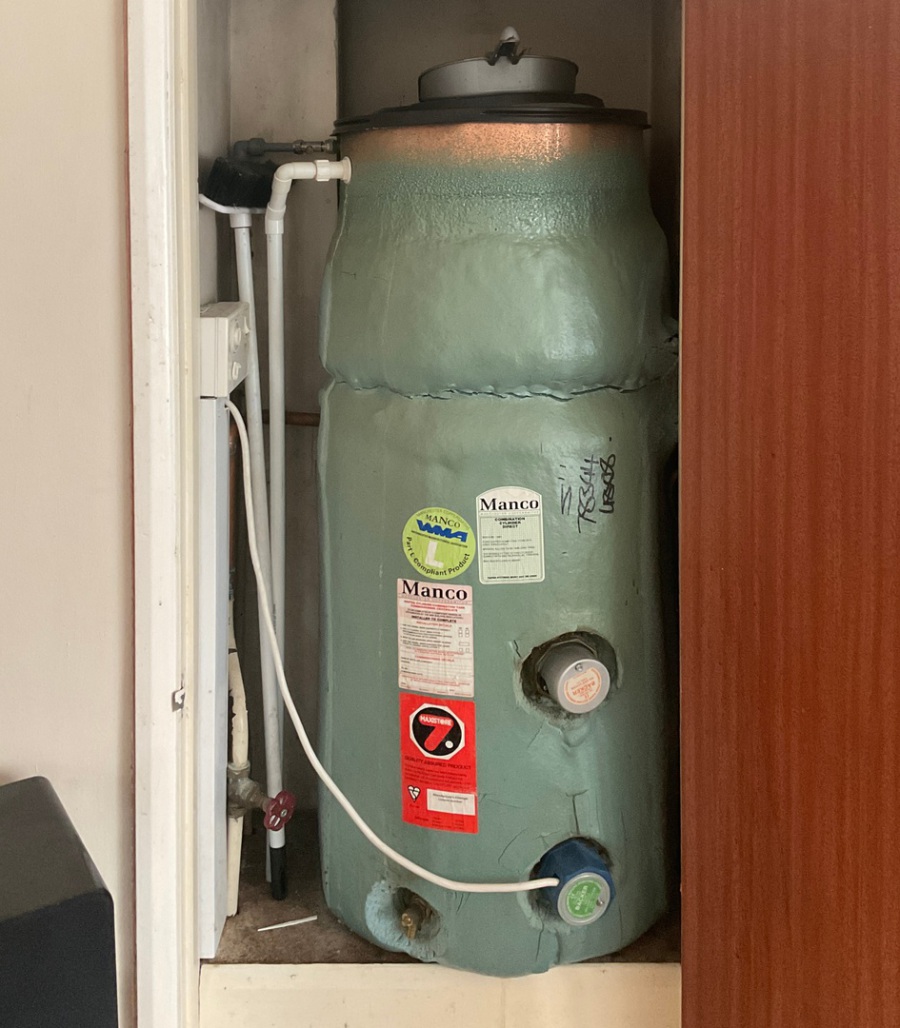 Fortic Tank with Foam Insulation and Twin Immersion Heaters
(The eagle-eyed will spot this cylinder has two immersion heaters but only one is connected. That's fine, power is provided through a timer, and the EPC methodology only requires two immersions to be present in the cylinder for us to declare it as dual-immersion/off peak, so long as the electric meter is dual-rate. It does not matter if one of the heaters is not connected)
This means the first two recommendations have already been implemented, so from the original EPC there is only one other recommendation remaining which is to upgrade the very dated 'modern slimline' storage heaters to High Heat Retention Storage Heaters.
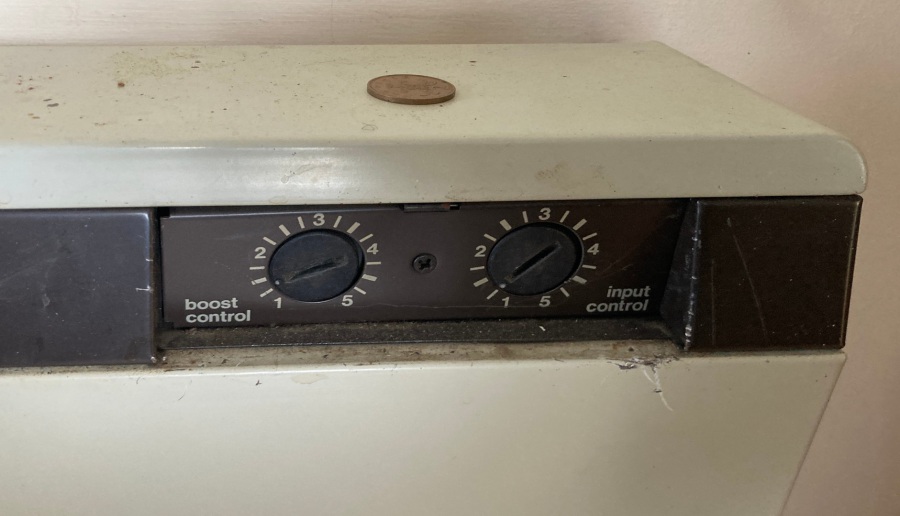 One of the old storage heaters
However, we have also fitted a Positive Input Ventilation (PIV) system in the flat which resolved a damp issue.
Unfortunately, as we will see soon, this actually reduces the EPC rating.
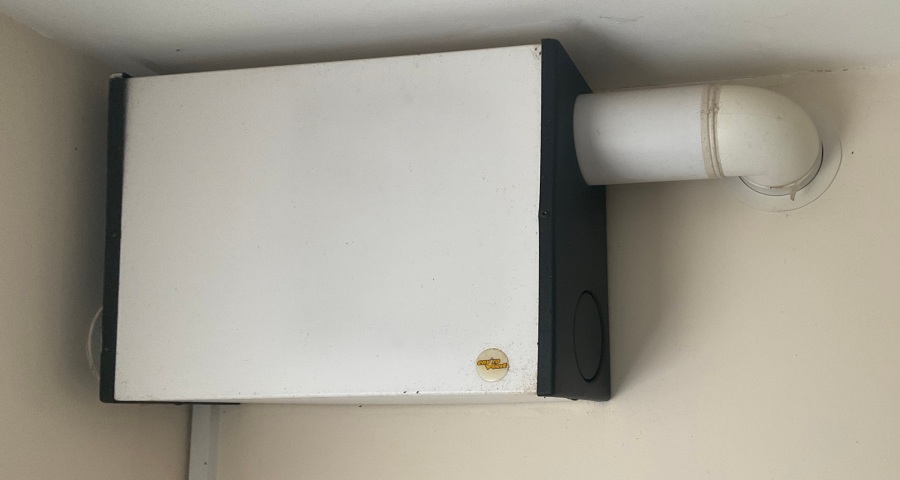 An EnviroVent 'PIV From Outside'
A New Baseline EPC Assessment
We've carried out a fresh EPC assessment to see where our current baseline rating is, and the result is 59D.
There are only two recommendations that would appear on the certificate:
| Step | Recommendation | Rating After |
| 1 | Floor Insulation (Solid Floor) | 65D |
| 2 | High Heat Retention Storage Heaters | 70C |
So there is a floor insulation recommendation now when there wasn't one before. That's partly because the floor type was incorrect on the previous EPC.
We would be very reluctant to implement solid floor insulation for several reasons.
The second recommendation however is for High Heat Retention Storage Heaters which we are happier with
If we implemented the High heat Retention Storage Heaters without the floor insulation then we would get a rating of 66D.
This is just 3 points shy of a C band rating, and the certificate would only indicate one recommendation which is the one for solid floor insulation to bring us up to 71C.
Updating the Main Heating System
There's currently no gas connection at this property, although there's evidence one may have been available in the past, so it might be easy to make available again.
Looking ahead, the government's future MEES proposals indicate gas heating would not be sufficient to score a 'C' in the Heating System metric on reformed EPCs. Due to this we would prefer to
stay with electric heating of some sort, and preferably one that would attract a C in the Heating System metric.
The most efficient form of electric heating would be an air source heat pump but we'd have to install radiators and pipes through the property and plan everything
ahead. We're limited on time so we're not going to follow that path.
We are aware that modern direct-acting electric panel heaters would significantly reduce the EPC rating despite significant marketing misinformation regarding efficiency.
Also, current government guidance is they would not be sufficient for a 'C' in the proposed Heating System metric either.
We've therefore chosen to proceed with High Heat Retention Storage Heaters (HHRSHs), and have installed a pair of Dimplex Quantums.
From limited information in government consultations, it appears likely these would be sufficient for a 'C' in the Heating System metric in the future, although we are still waiting a response to confirm this.
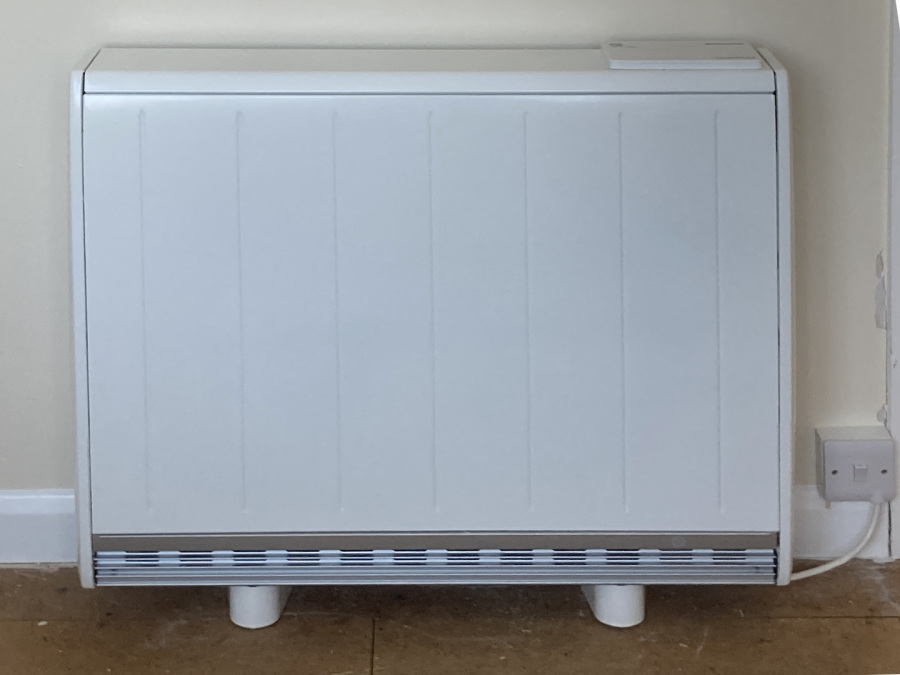 A High Heat Retention Storage Heater
The way HHRSHs currently work in the EPC methodology is interesting. You only need to install one of them to gain the benefit.
Adding additional HHRSHs does not currently result in a better rating, but we would need to make sure the lounge has a HHRSH and there are no other types of storage heater in the property.
Also, the declaration of electric panel heaters as Secondary Heating does not result in a reduction in EPC rating like it would if the main heating system was a gas boiler. The same is also true of un-heated habitable rooms in the property. Our electric rail heaters in the kitchen and bathroom therefore don't reduce the rating at this property.
We do not know yet whether this behaviour will continue under the new methodology (HEM) from 2027.
For further information see our High Heat Retention Storage Heaters page.
In the end, we fitted two new Dimplex Quantum HHRSHs and they're configured to operate on a single electric supply cable.
The electricity meter provides 'whole house' off-peak electricity at night, and charging times are set in the storage heaters themselves:
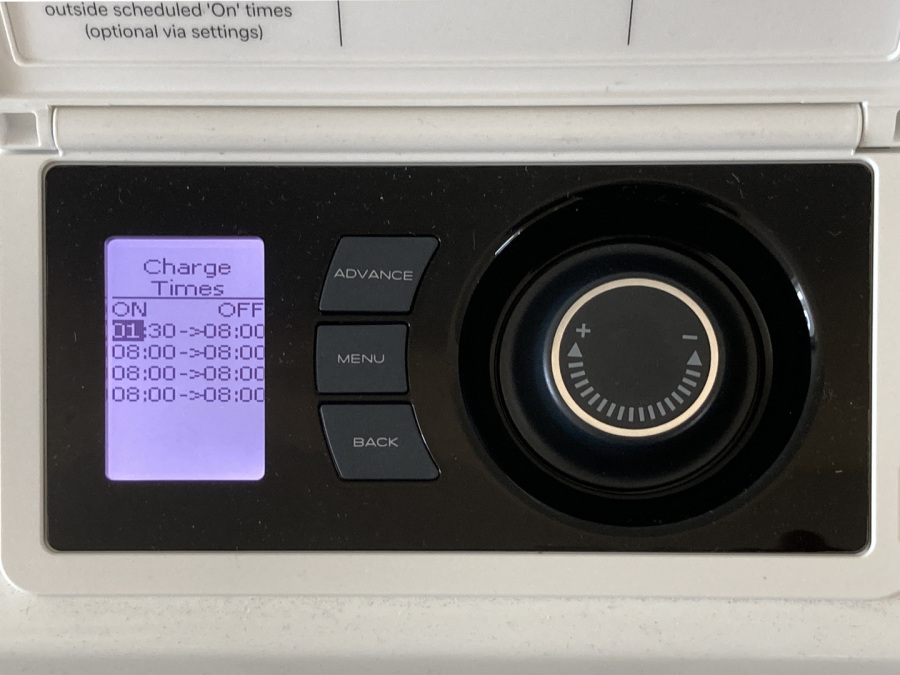 Advanced Charge Time Settings on the Dimplex Quantum HHRSH
So, we can update the assessment with the Quantums installed, and our EPC rating would now be a 66D.
This is 3 SAP points short of a 'C' under the current methodology, and there is now only one recommendation that would appear on an EPC if we lodged it now:
| Step | Recommendation | Rating After |
| 1 | Floor Insulation (Solid Floor) | 71C |
We're really keen to avoid installing Solid Floor Insulation becuase of the effort and cost involved, and the practical difficulties.
For more information take a look at our Solid Floor Insulation page.
So we need to look for other ways to obtain those 3 additional points.
The Challenge: Finding 3 More SAP Points
The EPC doesn't present any other improvement recommendations, but that doesn't mean we can't increase the rating.
Recommendations only appear on the EPC if they are:
- Programmed in the methodology, and
- Deemed relevant to the property, and
- Make at least 1 SAP point increase to the EPC rating (or 0.5 points in the case of lighting, draught proofing or hot water cylinder insulation).
However, smaller increases from recommendations not making it on to EPC can be combined together.
We can also consider improvement measures without a corresponding recommendation in the methodology too.
We can use the EPC assessment software to model various changes to the property and see what each could make to the final rating.
If we can't find a single improvement that provides three additional points, perhaps we can find a combination of measures that do.
We're used to seeing EPC ratings expressed as an integer value but behind the scenes they're actually calculated to 4 decimal places and then rounded to the nearest integer.
Some changes may be too small to flip the rating up to the next integer on their own but when added together with other measures can be enough to do so.
Let's model a range of improvements and see which ones deliver the greatest benefit
In the table we'll record the EPC rating to 2 decimal places to make it easier to read than four.
First, a quick recap on rounding 2 digit decimal numbers:
- A number with a decimal component of 0.50 to 0.99 rounds up to the next integer.
- A number with a decimal component of 0.01 to 0.49 rounds down.
Our new baseline is 66.14 D, and our target is 68.50 (which rounds up to 69).
We need to gain at least 68.50 - 66.14 = 2.36 SAP points.
As we look at the followng options, we must bear in mind that measures may provide varying gains depending on other measures that are implemented at the same time. This means for example that if we found a group of three measures which applied individually would contribute enough points to get us to a C, we would need to model all three of those measures together to confirm the combined gain.
Also, if we were interested in taking advantage of one or more of the proposed MEES exemptions from 2030 onwards, we should bear in mind that the cost of any improvement measures not listed on an EPC or similar report would not be eligible as counting towards the cost cap. That's at least how it works with the cost cap under the current regulations.
None of the measures listed here have appeared as recommendations on the EPC for this property:
| Description | Rating | Difference |
| Our new baseline | 66.14 D | - |
| Remove the 'PIV from outside' ventilation system | 68.97 C | +2.83 |
| Replace the lounge window (unknown date) with new double glazing | 66.81 D | +0.67 |
| Replace the kitchen window (unknown date) with new double glazing | 66.40 D | +0.26 |
| Replace the bedroom window (unknown date) with new double glazing | 66.62 D | +0.48 |
| Replace the lounge, bedroom and kitchen windows with new double glazing | 67.55 D | +1.41 |
| Replace the internal door separating the porch from the lounge with an external quality door such as a uPVC door with less than 60% glazing | 67D | +1 |
| Add '100mm' internal insulation (50mm PIR) to 6.31m2 of external wall against the garage. | 66.73 D | +0.59 |
| Swap out the hot water cylinder with electric instantaneous water heaters | 67.18 D | +1.04 |
| Air pressure test - 6m3/h/m2 (if we could achieve that result) | 67.10 D | +0.96 |
| Change to a gas boiler (Alpha Intec2 28X with/without electric 2ndry heating) | 65/68D | +2 |
| Gas boiler as above but with TTZC | 66D/69C | +3 |
| Change to an air source heat pump | ||
| Remove the dual-immersion hot water cylinder and replace with a Dimplex Edel | 68D | +2 |
| Change the electric shower to a mixer shower | 67.81 D | +1.67 |
| Change the electric shower to a mixer shower and change the current HWC to a Dimplex Quantum 125l | 68.17 D | +2.03 |
| Change the electric shower to a mixer shower and change the current HWC to a Dimplex Quantum 125l and replace the bedroom window with new DG. | 68.73 C | +2.59 |
| Change the electric shower to a mixer shower and change the current HWC to a Gledhill Pulsacoil 150l, and replace the bedroom window with new DG. | ||
| Change the electric shower to a mixer shower and fit a Recoup Easyfit+ WWHRS system to the bath | 68.72 C | +2.58 |
|
Change electric shower to mixer shower. Replace lounge window with new DG |
68.38 D | +2.24 |
| Change electric shower to mixer shower. Replace lounge and kitchen windows with new DG | 68.64 C | +2.50 |
| Change electric shower to mixer shower. Replace lounge, bedroom and kitchen windows with new DG |
69.12 C |
+2.98 |
PIV
Since the previous EPC was conducted, a Positive Input Ventilation (PIV) system was installed in the property to alleviate a mould issue. The system was manufactured by EnviroVent and is the 'PIV
from outside' type.
Presence of the PIV has reduced our EPC rating by 2.83 points, and simply removing this system would bring us up to a C in a single measure. Also, the cost of making good two holes in the wall would be minimal.
This would be a quick and simple option, but if we went down this path we should implement other measures to mitigate against the risk of condensation and mould. We could do this by replacing the PIV with a passyfier vent, adding trickle vents to the windows (none present currently) and increasing door undercuts.
However, we would prefer to leave the PIV present as we wish to rent the property again soon and do not want to risk mould occurring again. The PIV may also help with responsibilities under the renters right act that are coming in, should mould reappear.
New Double Glazing
By replacing the three older double glazed windows with new, we could gain up to 1.41 points.
The lounge window would give us 0.67 points.
The kitchen window would give us 0.26 points.
The bedroom window would give us 0.48 points.
We could also implement any of these individually in conjunction with other measures if we decide to do so.
For more information about how windows are assessed in EPCs, visit our Glazing page.
Gas Boiler
A central heating system centered on a modern gas combi boiler with smart TRVs to qualify for Time and Temperature Zone Control would give us enough points for a C.
We would need to get gas connected to the property, fit pipes and radiators throughout the flat and remove the electric secondary heating.
However, in the future we would also fall foul of the proposed Heating System metric in the increased MEES regulations. This is proposed for introduction in 2030 and will not allow gas boilers to reach a C rating.
For all these reasons, we intend to pass on this option.
For more information about how heating is assessed, look at our Heating Systems and Heating Controls pages.
Dimplex Edel
I love the idea of a heat pump hot water cylinder and the Dimplex Edel is a known brand but the retail price on it's own is around £2,500 just for the cylinder. It also requires ducting to the outside of the property, and we'd need to combine this with another measure to get the additional Points we need. We'll therefore seek other options first.
Fabric Performance
We are a little limited in options because the building fabric in a few areas is reasonable already. From the RDSAP 10 Specification document we can see that:
- A party wall declared as 'unable to determine' has a u-value of 0.0 (no heat loss).
- Also, for a roof declared as 'another dwelling above', the methodology also assumes there is no heat loss upwards.
- We have cavity walls with retrofitted cavity insulation, with an original 1967-1975 (band E) construction dateband (England & Wales) for which a u-value of 0.7 is used (it would have been 1.5 without the CWI).
Adding internal or external wall insulation to the already insulated cavity wall could be expensive for the points return and be slightly awkward.
Replace The Electric Shower With a Mixer Shower
Simply changing the electric shower to a mixer shower would gain us 1.67 SAP points taking us up to an integer rating of 68D.
A mixer shower might only cost £200 plus fitting, so at this price level this seems a pretty decent return on investment.
There's a complication with our property though.
The hot water pressure at the flat is low because it comes from a Fortic tank. We'd have to replace this with an unvented direct hot water cylinder to increase the pressure and make sure a mixer shower would work properly. This would come at additional expense and would also need to have two immersion heaters for EPC purposes. We would need to install a pressure relief pipe to the outside environment and the cylinder location is in the centre of the flat making that an interesting install.
Fortunately, a cylinder like this can also help increase our rating further, particularly where the heat loss performance of the chosen cylinder is known and can be entered into the assessment directly. This is measured in kW per 24 hours.
An example could be the Dimplex Quantum 125 litre cylinder at a list price of £1,000. This has a heat loss of 0.95 kW / 24hr.
This would bring our rating up by 2.01 points in total.
Then by also replacing the bedroom window we would get to 2.59 points and the C rating we seek.
Other cylinder brands are cheaper and the Gledhill Stainless ES 90 litre direct is another example with a list price of only £350 and a slightly smaller (better) heat loss figure.
Researching a bit more, I've found a thermal store which doesn't need a pressure relief pipe, and can also work without an overflow. It's the Gledhill Pulsacoil cylinder and is currently our favoured
option. The 150 litre model has a heat loss of 1.48 kW/24hr.
Our Preferred Route To A C
Our preferred improvement measures to get to a C under the current methodology, and which would also improve the hot water pressure are:
- Replace the electric shower with a mixer shower
- Replace the fortic tank with a Gledhill Pulsacoil 150l with dual immersion heaters
- Replace the bedroom window with a new double glazed window (currently u=1.4 or better)
None of these measures are presented as recommendations on our EPC certificate.
Our Current Decision
Having found this path to a C under the current methodology (RDSAP 10), we have actually decided to leave the property as it is, with a 66D and remodel it once the 'reformed' EPCs become available in late 2027.
We believe the property may reach a level C in the building fabric metric in the future, in its current configuration.
We also believe it might achieve a C in the Heating System metric too with the HHRSHs we have just installed.
We therefore might not need to implement any further measures to fulfil the proposed MEES regulations in England from 2030.
If these levels are not realised though, we will review the situation again and possibly implement the three measures above to get a C under RDSAP 10 which would see us through for 10 years under the proposed 'grandfathering' arrangement.
Costs
Our costs so far:
- Cavity wall Insulation & cylinder replacement £tbc
- Previous cylinder replacement £tbc
- 1 x Dimplex Quantum QM150RF + 1 x Dimplex Quantum QM100RF + 1 x Dimplex Hub = £1,850
- EICR plus new Consumer Unit plus fitting the HHRSHs = £965
Potential further costs:
- Hot Water Cylinder replacement and mixer shower - not implemented yet - wild estimate: £2000
- Replace bedroom window with new DG - not implemented yet - wild estimate: £650.
Key Lessons
- EPC recommendations do not reveal every possible route to a higher rating, but that’s fine and there are good reasons for this being the case
- High Heat Retention Storage Heaters improve the rating compared to older types of storage heater
- Ventilation measures can sometimes reduce EPC ratings
- Small improvements can be combined to achieve a higher EPC rating and potentially a higher band
- Waiting for EPC reform may sometimes be the most sensible option
Always consult a local domestic energy assessor before making changes to your property.
I hope this page has been interesting to read. Please take a look at our other EPC case studies.
 Print
Print 