
Suspended Timber Floor Insulation
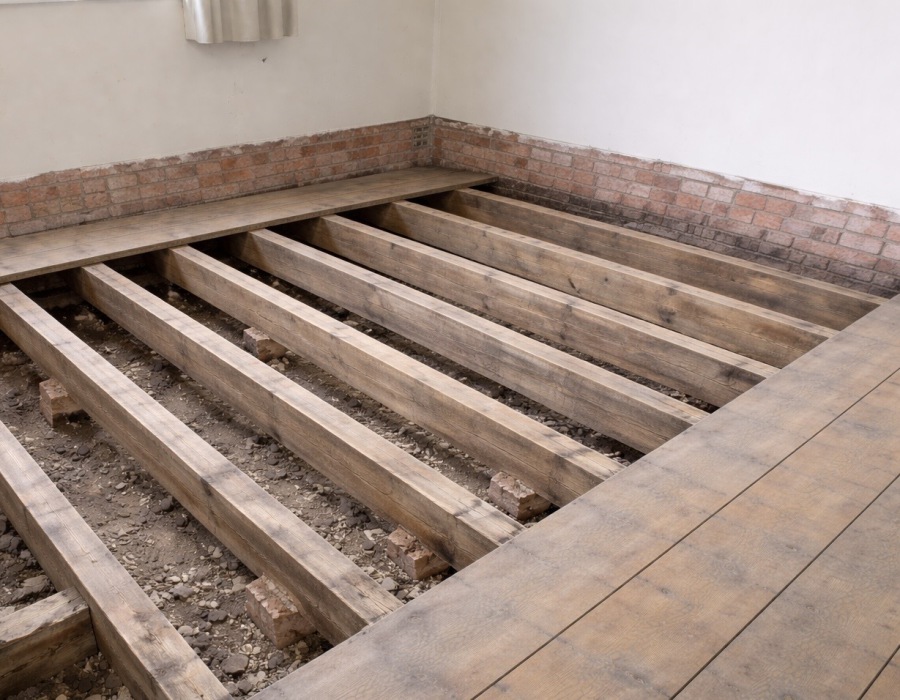 Suspended timber floor (AI approximation)
At the time of writing, the methodology for EPC assessments of existing dwellings is RDSAP 10. A significant methodology overhaul from RDSAP to the Home Energy Model (HEM) is proposed for 2026. In addition, government consultations indicate future changes to the format of EPCs and minimum rating levels required for private rental properties. Methods for improving EPC ratings will therefore change in the future.
Introduction
Typical forms of suspended ground floors include:
- Block and beam
- Suspended timber
Block and beam floors use concrete beams with a cross sectional shape that supports lines of parallel blocks traversing the gap to neighbouring beams. This forms quite a rigid floor.
Suspended timber floors in contrast use a series of parallel wood joists with perpendicular floorboards above. This forms a floor with noticeably more 'bounce'.
Both types create a void area under the floor which is normally ventilated to the outside using 'air bricks' which are visible low down on external elevations, usually just below the damp proof course, and below the level of the internal ground floor.
Particularly in the case of suspended timber floors, this ventilation ensures any air-bourne moisture permeating down from the room above cannot linger in the void and it reduces the potential for condensation, mould and degradation of the timber structure.
In modern construction, it's also possible to come across periscopic air bricks where a rectangular 'pipe' drops down through a cavity wall to the void, and allows the floor level inside to be at the same level as the ground outside.
We're interested on this page with suspended timber ground floors, and these are typically determined by:
- Air 'bricks' in the external elevations of the property, low down, usually just below the damp proof course.
- A floor that noticeably bounces when you drop your weight on your heels in the room.
- Timber floorboards visible if the floor does not have carpets etc.
In modern domestic construction, suspended timber floors are generally not used as the default type of floor. Most new homes now use ground bearing concrete slabs with insulation above or below. This provides better air tightness, is easier to detail for Part L energy efficiency and reduces moisture and ventilation risks.
EPC Assessment - u-values
Unless manually overridden by the assessor, the U-value of a suspended timber floors is calculated according to BS EN ISO 13370.
Floor U-values are obtained separately for the main dwelling and for any extension, using the applicable area,
exposed perimeter and wall thickness.
The interesting equation is indicated in section 5.12 of the RDSAP 10 Specification document.
EPC Assessment - Insulation Options
For a suspended timber floor, it's possible to record the depth of retrofitted insulation in an EPC assessment.
The range of depths that can be recorded are from 25mm to 200mm, in 25mm steps.
If the insulation material is mineral wool then the thickness is recorded as the actual depth measured.
For other material types, if documentary evidence is available of the type of insulation and the manufacturer's data that the lambda value (thermal conductivity) is equal to or less than 0.025 W/mK then the thickness can be recorded as double that as measured (Convention 3.07).
Of course, if no evidence of reftrofitted insulation is available, the floor will be declared 'As Built'.
Overriding u-values
The floor u-value, just like that for any other building part can be overridden by an energy assessor, but qualifying documentary evidence must be provided to support this.
This will also result in a Smart Audit trigger on a resulting EPC, making it highly likely that the EPC will be audited by the accreditation scheme.
Suspended timber floor insulation - best practice
The government have produced a comprehensive 'best practice' guide for installing insulation in suspended timber floors.
This is available here:
https://www.gov.uk/government/publications/insulating-suspended-timber-floors-best-practice
My EPC Rating
My house actually has solid floors but if I were to simulate a suspended timber floor in an assessment, and add some insulation, here are the ratings I would achieve:
This is a 1950s terraced house that we cover in our Case Study 2 page. The ratings here were calculated using the previous release of RDSAP (V9.94):
| Insulation Status | EPC Rating |
| As Built | 68D |
| 50mm Retrofitted | 69C |
| 100mm Retrofitted | 69C |
| 150mm Retrofitted | 69C |
| Unknown | 69C |
So the difference for my property is small considering the amount of physical work required and the cost of materials.
The increase from 50mm to 100mm and then 150mm does not result in an integer increase in the EPC rating for my property but it will be making a smaller fractional difference behind the scenes, just unfortunately not enough to be rounded up to the next integer value of 70.
It would be possible to do this type of work as a DIY project but you would need to submit a formal Building Control application with exact details of the materials used so that the documentary evidence could be used by an energy assessor to support the declaration of the insulation in the EPC assessment.
Always contact a local energy assessor and get them to work out what EPC rating improvement you would experience with your own property before proceeding with any works.
EPC Recommendation
A recommendation for Suspended Floor Insulation will be included on an EPC certificate under the following conditions:
- Below the building part there is:
- Ground or External Air or Unheated Space, and
- The floor is Suspended
And:
- The Floor has:
- No insulation or
- A U value of > 0.7 W/m2K
The EPC rating indicated on the certificate with this recommendation implemented will have been calculated using:
- Insulated Floor with
- U value = 0.25 W/m2K
- For a park home, u value = 0.30 W/m2K
Click here to return to our 'Improve Your EPC' main page, and see if there is another way you could improve your EPC rating.
 Print
Print 