
Waste Water Heat Recovery Systems (WWHRS)
The current methodology for EPC assessments of existing dwellings in England and Wales is RdSAP 10. The Government plans to introduce reformed EPCs based on the Home Energy Model (HEM) in the second half of 2027.
Changes to EPC metrics will also affect how property energy performance is reported and how future Minimum Energy Efficiency Standards (MEES) are assessed. For privately rented homes in England and Wales, the Government has set 1 October 2030 as the compliance date for the new MEES standard.
These changes mean that the measures needed to improve a property's current EPC rating may not necessarily be the same as those required to meet future standards. The guidance on this page relates primarily to the current RdSAP methodology.
At A Glance
In this section we'll learn:
- What is WWHRS? A Waste Water Heat Recovery System captures heat from warm waste water, usually from a shower, and uses it to preheat incoming cold water.
- How does it work? A heat exchanger transfers heat between the outgoing waste water and incoming clean water, without the two supplies coming into contact.
- What are the different configurations? There are three main arrangements: System A supplies preheated water to both the shower and hot water system; System B supplies the shower only; and System C supplies the hot water system only.
- Can WWHRS be retrofitted? Yes. Some products are designed for installation in existing properties, including self-contained units that can be fitted beneath a bath.
- Does it improve an EPC rating? It can. However, the improvement depends on the property, the hot water arrangements and the particular WWHRS installed.
- Does the product need to be approved? The exact make and model must be listed in the Product Characteristics Database (PCDB) to be recognised in an RdSAP 10 assessment.
- Is it worth installing? Potentially, but the EPC improvement can be relatively modest compared with the cost of the equipment and installation. It's worth modelling the likely benefit before committing to the expense.
Introduction
A Waste Water Heat Recovery System (WWHRS) is designed to recover some of the heat that would otherwise be lost when hot water goes down the drain, most commonly during showering.
Rather than allowing all that heat to go to waste, the system uses a heat exchanger to transfer some of it to incoming cold water. This preheated water can then be supplied to the shower, reducing the amount of additional energy needed to bring the water up to the required temperature.
The benefit is relatively straightforward: less energy is needed to provide hot water, which can improve the energy efficiency of the property and potentially increase its EPC rating.
There are several different ways of configuring a WWHRS, depending on how the recovered heat is used and how the system is connected to the property's plumbing. Some arrangements are more suited to new-build properties, while others can be retrofitted into existing homes.
In this guide, I'll look at how WWHRS technology works, the different system configurations, and how these systems are treated under the current RdSAP 10 methodology. I'll also look at the potential EPC improvement and whether installing one is likely to represent good value for money.
How Does WWHRS Work?
Most domestic WWHRS installations are instantaneous systems designed to recover heat from waste water produced while someone is having a shower.
As the warm waste water flows towards the drain, it passes through a heat exchanger. At the same time, incoming cold mains water passes through a separate pipe within the heat exchanger. Heat is transferred from the outgoing waste water to the incoming cold water, raising its temperature before it reaches the shower or hot water system.
The two water supplies remain completely separate – the system transfers heat, not waste water. This means that the incoming clean water is preheated without coming into contact with the water going down the drain.
Because the incoming water is already warmer, less additional heat is needed to bring it up to the required temperature. Depending on the plumbing arrangement, the preheated water can be supplied directly to the cold-water inlet of the shower, to the hot water system, or to both.
One important characteristic of an instantaneous WWHRS is that heat recovery takes place while the shower is running. It therefore relies on a simultaneous flow of warm waste water and incoming cold water. Unlike some other heat recovery arrangements, it cannot recover heat from bath water once the bath has been emptied.
The amount of heat recovered will depend on factors including the temperature and flow rate of the waste water, the incoming cold-water temperature and the performance of the particular heat exchanger.
Although this guide concentrates primarily on instantaneous systems, storage-based WWHRS arrangements also exist and are treated differently under the assessment methodology
The Different WWHRS Configurations
There are three recognised plumbing configurations for instantaneous Waste Water Heat Recovery Systems, commonly referred to as Systems A, B and C.
The difference between them is how the water that has been preheated by the heat exchanger is used.
System A – Feeding Both the Shower and Hot Water System
System A is a balanced arrangement in which the preheated water is supplied to both the shower and the hot water system.
This allows the recovered heat to benefit both sides of the shower's water supply. The preheated water supplied to the hot water system reduces the amount of energy needed to produce hot water, while the preheated supply to the shower also reduces the amount of additional heating required to achieve the desired shower temperature.
System B – Feeding the Shower Only
With System B, the preheated water is supplied directly to the shower, rather than being routed to the hot water system.
This arrangement can be particularly useful when retrofitting a WWHRS into an existing property, as it may be possible to connect the unit to the shower's cold-water supply without making substantial changes to the existing hot water system.
For example, a self-contained unit installed beneath a bath can recover heat from the bath's waste water and use it to preheat the incoming cold-water supply to a mixer shower fitted above the bath.
This is the arrangement I am considering for my own property.
System C – Feeding the Hot Water System Only
System C takes a different approach. The preheated water is supplied to the combi boiler or other hot water system, but not directly to the shower.
The recovered heat therefore reduces the amount of energy required by the hot water system to produce domestic hot water. The shower itself continues to receive its cold-water supply separately.
Which Configuration Is Best?
The three arrangements are not interchangeable in every property. The most suitable option will depend on the existing plumbing, the type of hot water system and the way the shower is supplied.
System A makes use of the recovered heat in both the shower and the hot water system, while Systems B and C direct it to one or the other.
The performance of a particular WWHRS also depends on the product itself. When a system is entered into a SAP calculation, the relevant performance data is selected from the Product Characteristics Database (PCDB), including the appropriate system configuration.
It is therefore important to check that the product being considered is listed for the intended installation arrangement, rather than assuming that the performance figures for one configuration will apply to another.
WWHRS and EPC Assessments
Although WWHRS technology can improve the energy efficiency of a property, there are specific requirements that must be met before a system can be recognised in an EPC assessment.
The Product Characteristics Database (PCDB)
To include a WWHRS in an RdSAP 10 assessment, the manufacturer's brand name and model must be listed in the Product Characteristics Database (PCDB), which is maintained by the Building Research Establishment (BRE).
The database contains the performance information used by the assessment software. When selecting a WWHRS, the assessor must identify the correct product and, where applicable, its particular system configuration.
If the device cannot be found in the PCDB, there is no default performance figure that can be substituted. The system must therefore be excluded from the EPC calculation, although its presence should be recorded in the assessor's site notes.
This makes it particularly important to check the PCDB before purchasing a WWHRS. A product may be perfectly capable of recovering heat, but unless it can be recognised by the assessment methodology, it won't contribute to the EPC rating.
The Importance of the Shower Type
For instantaneous WWHRS, the type of shower installed is also important.
Under the RdSAP conventions, only mixer showers count for instantaneous WWHRS. A mixer shower is one where the hot water is supplied by a boiler, heat pump or immersion heater, rather than being heated electrically as it passes through the shower unit.
The shower must also be a permanent installation. A shower attachment that is temporarily connected to bath taps does not qualify.
This means that simply fitting a WWHRS to an electric shower will not result in the system being recognised in the RdSAP assessment.
When Will RdSAP 10 Recommend WWHRS?
RdSAP 10 includes a specific recommendation for installing waste water heat recovery.
However, the recommendation is only considered where the property has a mixer shower and does not already have WWHRS installed. It is also restricted to properties where hot water is provided by a storage cylinder or a combi boiler.
Where these conditions are met, the recommendation is to install WWHRS for each shower.
The recommendation is numbered 49 in the RdSAP 10 specification, and will only appear if at least 1 SAP point increase results in the EPC rating.
Checking Before You Buy
If you're considering installing a WWHRS to improve your EPC rating, I'd suggest checking three things first:
- Is the exact make and model listed in the PCDB?
- Is it listed for the plumbing configuration you intend to install?
- Does your existing shower and hot water arrangement meet the requirements for it to be recognised in an RdSAP assessment?
It's also worth asking a local Domestic Energy Assessor to model the proposed improvement before committing to the installation. The resulting increase in your EPC rating may be smaller than you expect, and the cost of installation needs to be considered alongside the potential benefit.
Retrofitting a WWHRS
Although WWHRS is often associated with new-build properties, it is also possible to install these systems in existing homes. However, the practical options will depend on the layout of the bathroom, the position of the shower and the existing plumbing.
One of the simplest arrangements for a retrofit may be a self-contained heat recovery unit installed beneath a bath. These units are designed to recover heat from the waste water leaving the bath and use it to preheat the incoming cold-water supply to a mixer shower.
This can be particularly convenient where a shower is installed over the bath, as the heat exchanger can potentially be fitted into the existing plumbing without having to make extensive alterations elsewhere in the property.
Other installations may involve a vertical heat exchanger fitted to the shower waste pipe. These can be effective, but the available space beneath the shower and the route of the waste pipe may make installation more complicated.
Things to Consider Before Installing
Before purchasing a WWHRS, there are a few practical considerations worth checking:
- Shower arrangement: The system needs to be compatible with the type of shower and plumbing configuration in the property.
- Available space: There must be sufficient room to accommodate the heat exchanger and any associated pipework.
- Drainage: The unit needs to be connected into the shower waste pipework, with suitable access for installation and maintenance.
- Hot and cold water supplies: The existing plumbing must allow the recovered heat to be used in the intended way.
- Product compatibility: Check that the exact make and model is listed in the PCDB and that the appropriate system configuration is available for the intended installation.
It's also worth remembering that WWHRS is only recovering some of the heat that would otherwise be lost down the drain. It doesn't replace the need for a conventional hot water system, and it won't eliminate the energy required to heat water for a shower.
For an existing property, the cost and disruption involved in installation need to be weighed against the likely energy savings and potential improvement to the EPC rating.
A Worked Example – The Recoup Easyfit+
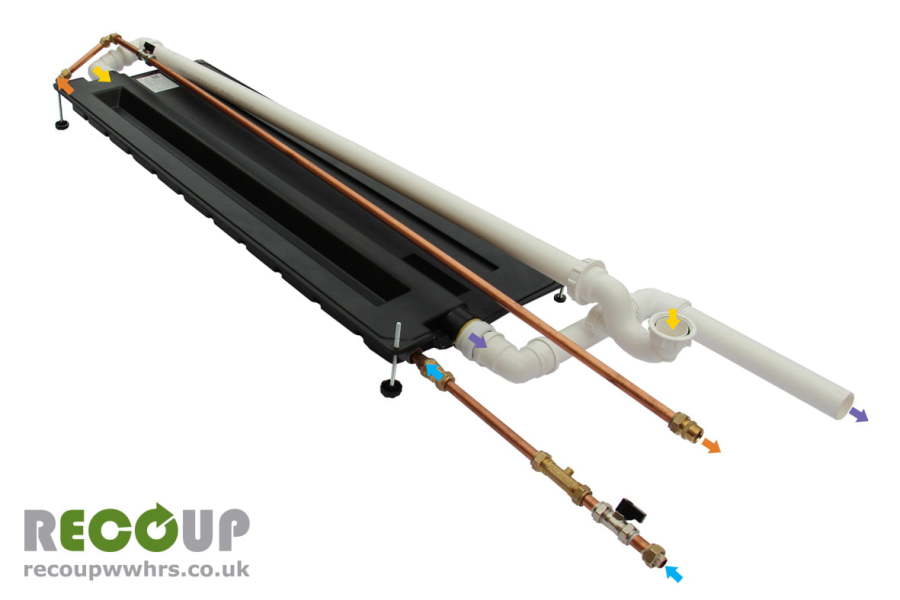
Having looked at the different WWHRS configurations, I wanted to see what difference installing one might make to the EPC rating of my own property.
My house is a mid-terraced property built in the 1950s, with a mixer shower installed over the bath. This makes a self-contained unit fitted beneath the bath a potentially practical retrofit option.
The product I've looked at is the Recoup Easyfit+, which is designed to recover heat from the bath or shower waste water and use it to preheat the incoming cold-water supply to the shower.
For my property, I modelled the installation using the System B configuration, where the recovered heat is used to preheat the water supplied to the shower.
What Difference Does It Make to the EPC Rating?
The modelling showed an improvement of 0.5461 SAP points.
Although this is a relatively modest increase, it is worth remembering that EPC ratings are expressed as whole numbers. An improvement of just over half a point can be enough to increase the displayed rating by one point, depending on the property's starting position.
For example, a property with an underlying rating of 68.00 would increase to 68.55 following an improvement of 0.55 SAP points. Although the underlying score remains below 69, it would be rounded to a displayed EPC rating of 69, moving the property from band D into band C.
Of course, the same installation would not necessarily produce the same improvement in another property. The result will depend on the existing hot water arrangements, shower configuration and the performance data for the particular WWHRS being assessed.
Is the Installation Cost-Effective?
The Recoup Easyfit+ was priced at approximately £650 for the unit, before allowing for installation costs.
When you consider the relatively small EPC improvement in my example, the cost per SAP point is quite high compared with some other potential improvements.
However, the value of an improvement isn't always just about the number of SAP points gained. If a property is already close to the next EPC band, even a relatively small improvement could make a difference.
For anyone considering this type of installation, I'd recommend getting the likely EPC improvement modelled before committing to the purchase. This will help establish whether the potential benefit justifies the cost.
Is WWHRS Worth Installing?
Waste Water Heat Recovery Systems are an interesting way of improving the energy efficiency of a property, particularly because they recover heat that would otherwise be lost down the drain.
However, whether installing one makes financial sense will depend on the property, the installation cost and how frequently the shower is used.
Potential Energy Savings
The main benefit of WWHRS is that it reduces the amount of energy needed to heat water for showering.
The actual savings will depend on several factors, including the number of occupants, how often showers are used, their duration and the performance of the particular system.
A household with several people regularly using the shower may benefit more than a property where showers are used infrequently.
The EPC Benefit
As my own example demonstrates, the improvement in an EPC rating can be relatively modest. My modelling showed an increase of 0.5461 SAP points for a System B installation.
That doesn't necessarily make WWHRS unattractive. If a property is close to the threshold of the next EPC band, a relatively small improvement could be enough to move it into that band.
However, if the property is some distance away from the next threshold, the same installation may make very little practical difference to its displayed EPC rating.
Installation Costs
The cost of the equipment and installation needs to be considered alongside the potential savings.
At approximately £650 for the Recoup Easyfit+ unit alone, before installation costs, this is not necessarily a cheap way of gaining a relatively small number of SAP points.
There may be other improvements available which provide a greater increase in the EPC rating for a similar investment.
My View
I think WWHRS is an interesting technology, and one that makes good use of energy that would otherwise be wasted.
However, I wouldn't automatically recommend installing one purely to improve an EPC rating. The relatively modest improvement in my own property, combined with the cost of the equipment and installation, means that there are likely to be more cost-effective options in many cases.
Where a property is already close to the next EPC band, or where the installation can be incorporated into a bathroom refurbishment, the economics may look more attractive.
As with any proposed EPC improvement, I'd recommend modelling the likely result before spending money. That way, you can establish whether WWHRS is a sensible investment for your particular property.
Having said all of this, I've actually managed to purchase a Recoup Easyfit+ for a very reasonable £250 on eBay.
When combined with another change to my property – switching from a dual-rate electricity tariff to a single-rate tariff – the two changes together are sufficient to increase my EPC rating from 68D to 69C.
It's a useful reminder that relatively small improvements can sometimes make the difference between EPC bands, particularly where a property is already close to the next threshold.
Key Takeaways
- Recovering wasted heat: WWHRS captures some of the heat that would otherwise be lost down the drain when taking a shower, using it to preheat incoming cold water.
- Three main configurations: Systems A, B and C differ in how the recovered heat is used, with the preheated water supplied to the shower, the hot water system, or both.
- Suitable for retrofitting: Although often associated with new-build properties, some WWHRS products can be installed in existing homes, including self-contained units fitted beneath a bath.
- PCDB recognition is essential: To be included in an RdSAP 10 assessment, the product must be listed in the Product Characteristics Database, with the correct system configuration selected.
- Shower type matters: The current RdSAP 10 methodology has specific requirements for recognising WWHRS, including the type of shower and hot water system installed.
- EPC improvements can be modest: My own modelling showed an increase of 0.5461 SAP points from a System B installation. Whether this is enough to improve the displayed EPC rating will depend on the property's starting score.
- Consider the cost: WWHRS can reduce the energy needed to heat water, but equipment and installation costs need to be weighed against the likely energy savings and EPC improvement.
Click here to return to our 'Improve Your EPC' main page, and see if there is another way you could improve your EPC rating.
 Print
