
Analysing the HEM EPC Wrapper
Repository Location & Disclaimer
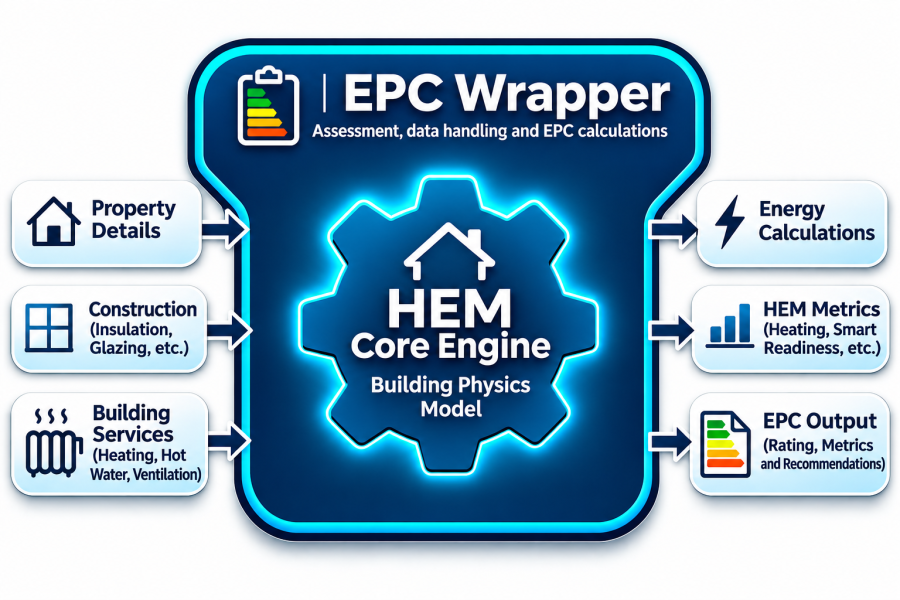
We are looking at the EPC Wrapper for the Home Energy Model, the python reference code being available here:
Please be aware that the code we are looking at here (November 2026) should not be treated as a definitive representation of the final HEM/HEMIE methodology. This publicly available version is incomplete, remains under development and is subject to change. It should not be relied upon in any way.
The repository's README file makes this clear, stating:
“The EPC wrapper is currently in development and should not be used for any official purpose.”
The comments on this site are of the code at the time of anaylsis.
The comments on this site may be wrong.
Please use your own due diligence and look at the code yourself to confirm anything important.
Taking a closer look at the EPC wrapper code
The EPC wrapper repository contains two subfolders; 'hemie' and 'epc-wrapper'.
| Component | What it does |
|---|---|
| HEMIE | Takes reduced inputs for an existing dwelling and expands them into EPC-wrapper inputs. Its README describes that purpose and shows a separate hemie command. |
| EPC wrapper | Runs the HEM calculation and calculates EPC metrics. Its epc command can also accept HEMIE-format sections and convert them during input validation. |
The wrapper README explains that HEMIE sections are converted as part of the wrapper’s own validation, so the normal epc command can run them. That makes HEMIE a separate
package, but part of the wrapper’s input workflow
If you're particularly interested, you can explore the Python code yourself.
Looking into the code
If you are particularly geeky, you can simply look through the code manually. That is fine but may take some considerable time.
Another method however is to use an AI agent to examine the codebase and answer questions about how it works. This is the approach I took before following up by examining specific sections of the code in more detail.
The following sections and pages contain information gleened in this way:
Currently not included
The wrapper is not complete and is still under development.
Notably there are no improvement recommendations or associated presentation logic for measures that could improve the EPC ratings.
Perhaps these might be included in a separate presentation layer, or perhaps addedd to the wrapper at a later date.
Also, the code currently does not allocate bands A to G to the first three main metrics.
This is not surprising considering the government have not yet provided an update following the HEM:EPC consultation, which contained discussion about the band thresholds.
The HEM EPC Metrics
First, lets look at the 5 metrics proposed to be displayed on new EPCs from late 2027. There are the four main metrics plus the legacy EER metric.
The following pages describe how each of these metrics is calculated:
 Print
