
Lighting in HEM – No More Counting Light Bulbs!
Introduction
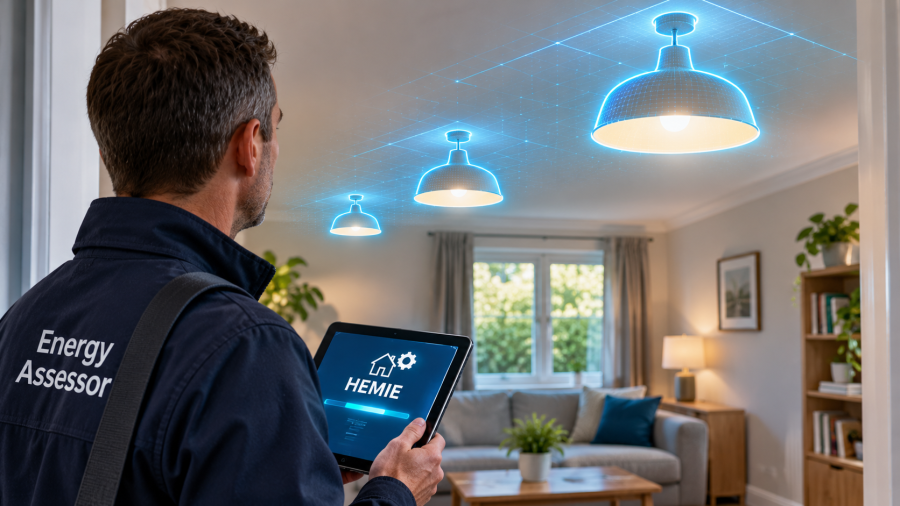
One of the changes energy assessors can expect under the new Home Energy Model (HEM) methodology is that there will no longer be a requirement to count individual light bulbs or establish their type.
Unlike the current RdSAP methodology, HEMIE (Home Energy Model Input Expansion) generates an assumed lighting configuration automatically. The actual lighting installation within the property is not used.
Let's take a look at how this works in the published Python reference code.
A note on the published code
The HEM EPC Wrapper is a developing reference implementation and is not intended for use in producing official Energy Performance Certificates. The code remains subject to change, and some elements of the eventual EPC methodology, including recommendation logic and metric band thresholds, are not yet represented in the published version.
The explanations and examples on this page are based on examination of the publicly available repository at the time of writing. They are intended to explore how the current code works, rather than describe a completed or definitive version of the future EPC assessment process.
An assumed lighting configuration
HEMIE contains a dedicated lighting model which creates an assumed set of light bulbs based on the property's total floor area.
The Python code defines three default values:
- Bulb power: 8W
- Bulb efficacy: 100 lm/W
- Required lighting output: 330 lm/m2
The number of bulbs is calculated to provide at least 330 lumens of lighting output for every square metre of floor area.
The calculation is:
Number of bulbs = (330 × Total Floor Area) ÷ 800
The result is rounded upwards to the next whole bulb.
For example, consider a property with a total floor area of 100 m²:
-
Required lighting output: 100 × 330 = 33,000 lumens.
-
Output per assumed bulb: 8 W × 100 lm/W = 800 lumens.
-
Number of bulbs: 33,000 ÷ 800 = 41.25.
The model therefore generates an assumed configuration of 42 bulbs, each rated at 8 W with an efficacy of 100 lm/W.
This configuration is generated automatically by HEMIE, rather than being based on an inspection of the actual lighting installation.
Is lighting allocated to individual rooms?
No separate lighting allowance for individual room types is apparent in the implementation.
The lighting configuration is generated using the total floor area of the dwelling and assigned to its thermal zone.
Consequently, the model does not distinguish between kitchens, bedrooms, bathrooms or living rooms when establishing the assumed bulb configuration.
Calculating annual lighting consumption
Once the assumed lighting configuration has been generated, the EPC wrapper calculates the property's annual lighting energy requirement.
Interestingly, this uses a different calculation, based on the property's total floor area and assumed occupancy.
The formula implemented in the Python code is:
Annual lighting requirement = 1139 × (TFA × O)^0.39
Where:
-
TFA = Total Floor Area (m²).
-
O = Number of Occupants.
The wrapper then calculates the electricity consumption by dividing the lighting requirement by the overall lighting efficacy.
Where the assumed lighting capacity is insufficient to meet the calculated requirement, the wrapper introduces supplementary lighting, using an assumed efficacy of 21.3 lm/W.
Lighting profiles and heat gains
Lighting consumption isn't simply distributed evenly throughout the year.
The EPC wrapper uses standardised monthly profiles to distribute lighting demand across half-hourly intervals. It also applies a daylight correction factor, accounting for the contribution of natural daylight.
Lighting also contributes to the internal heat gains within the dwelling.
The wrapper applies a gains fraction of 0.85, meaning that 85% of the modelled lighting electricity consumption is treated as internal heat gains. The remaining 15% is attributed to external lighting.
These gains are incorporated into the HEM calculation and can therefore influence the modelled space-heating requirement.
What does this mean for energy assessors?
The change is quite significant when compared with RdSAP.
Under the current methodology, assessors need to establish the number and type of fixed lighting outlets and record the relevant lighting characteristics.
Under the HEMIE implementation examined here, the lighting configuration is generated automatically using standardised assumptions.
For example, two otherwise identical properties will receive the same assumed lighting configuration, even if one has predominantly LED lighting and the other still has halogen bulbs.
Replacing halogen bulbs with LEDs would therefore not directly improve the EPC result through the lighting configuration under this implementation.
Summary
The published HEMIE and EPC wrapper code demonstrates a different approach to modelling domestic lighting:
-
Individual bulbs do not need to be counted.
-
Actual bulb types and wattages are not used to generate the HEMIE lighting configuration.
-
An assumed bulb power of 8 W and efficacy of 100 lm/W are used.
-
The assumed number of bulbs is calculated from total floor area.
-
Annual lighting demand is calculated using floor area and occupancy.
-
Standardised half-hourly profiles and daylight corrections are applied.
-
Lighting contributes to internal heat gains within the dwelling.
This is a notable departure from RdSAP, where the actual lighting installation forms part of the assessment.
Source: Published HEMIE and EPC wrapper Python reference implementation, particularly hemie/models/lighting.py, hemie/models/dwelling.py and epc_wrapper/preprocessing/appliances.py.
Note: These findings relate to the version of the reference implementation examined. The code remains under development and the assumptions may change before the final methodology is introduced.
 Print
